The cafeteria at the Diakonie-Klinikum Stuttgart is a place for everyone: patients can dine with their loved ones, visitors can grab a coffee and staff can take a short break from their daily hospital routine. In the kitchen behind the cafeteria, fresh meals are prepared daily—for many people and a wide range of needs. For the cooks, this daily routine can sometimes be stressful, especially when the ventilation system fails—which is exactly what happened in the spring of 2026.
approx. 2-year payback

approx. -40 % energy


Cooking generates heat, moisture, odors and greasy exhaust air. All of this must be safely vented while simultaneously allowing an inflow of fresh air. So when the roughly 25-year-old belt-driven fans in one of the kitchen’s four ventilation systems were no longer able to cope with the load, the system failed. The situation rapidly became critical—for working conditions, hygiene and food service.
“It was important to us that the kitchen staff could quickly return to working under safe and reliable conditions,” says Klaus Uetrecht, technical director of the Diakonie-Klinikum Stuttgart. Accordingly, ProActiveAir, a long-standing partner of the hospital, undertook a retrofit of the kitchen ventilation system, and turned to ebm-papst for the design of the new fan technology. Together, they identified four systems for modernization: one large supply-air system and three exhaust-air systems for the various kitchen areas.

It was important to us that the kitchen staff could quickly return to working under safe and reliable conditions.
Klaus Uetrecht, Technical Director Diakonie-Klinikum Stuttgart
This also aligned with a broader goal of the hospital. The Diakonie-Klinikum Stuttgart’s Green Team spans various professional groups—from medicine and nursing to engineering and human resources—and is committed to the hospital’s sustainability goals. In the technical department, the primary focus is on reducing energy consumption and CO₂ emissions. Outdated ventilation systems are a key area for improvement here: They often don’t operate according to actual needs, and thus they consume energy unnecessarily.

Retrofit without disrupting hospital operations
Despite the ventilation system being out of service, staff, patients and visitors naturally couldn’t go without meals. Kitchen operations therefore continued as usual—and the retrofit had to take place during breaks in food preparation. For the teams from the building services, ProActiveAir and ebm-papst, this meant an unusual work schedule—the systems that were still operational would be shut down starting in the afternoon and had to be running reliably again by around 6 a.m. each morning.
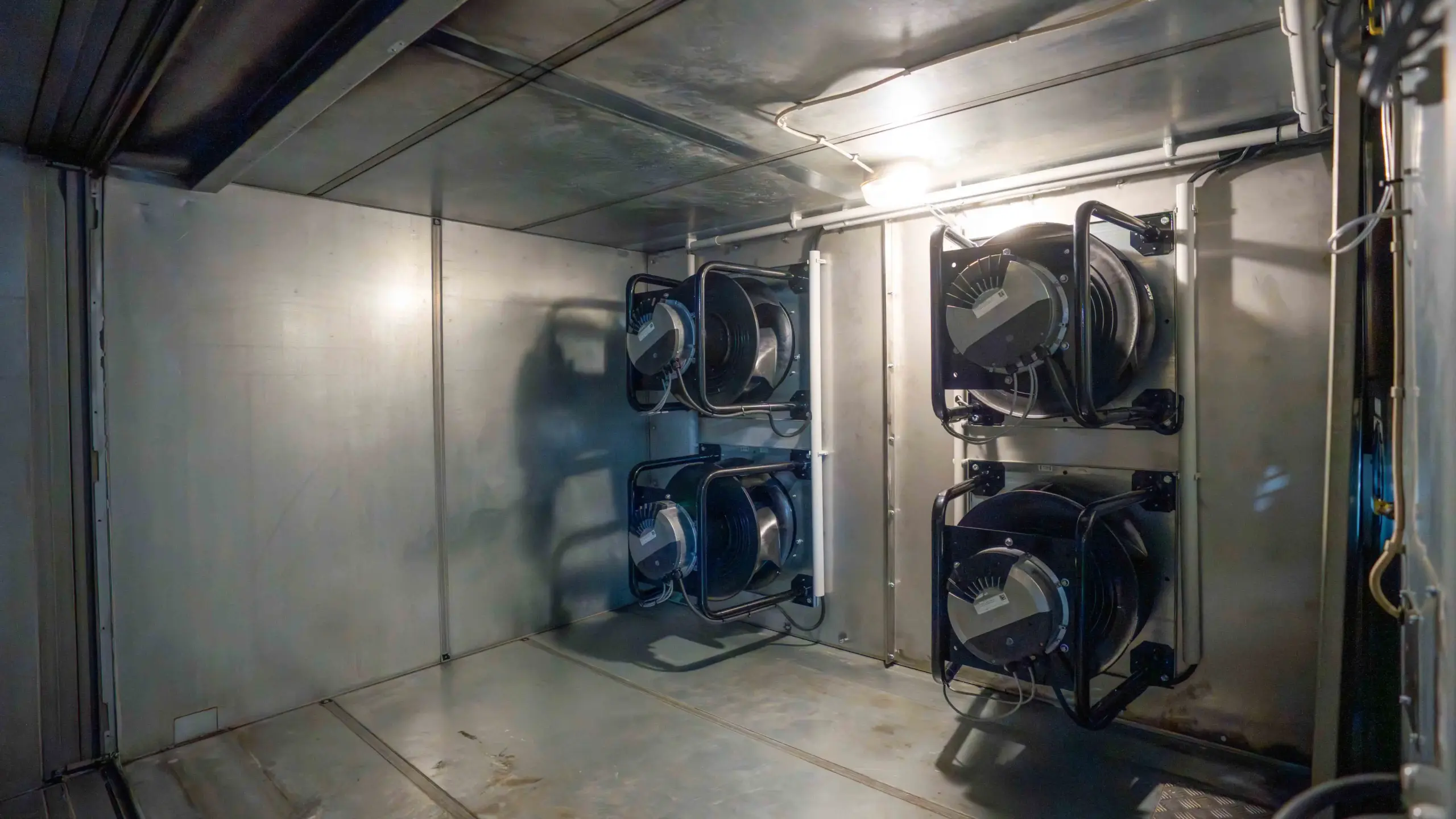
Four RadiPac C fans now operate together in a FanGrid within the large supply-air system. This distributes the airflow across multiple units, which increases the operational reliability of the kitchen ventilation system. (Image | Lukas Zwiessele)

Radial fans designed for grease-laden kitchen exhaust air are used in the exhaust systems of the hot kitchen. Their motor electronics are cooled separately to ensure reliable operation, even with warm exhaust air. (Image | Lukas Zwiessele)
The technicians removed the old fans, installed the new equipment, integrated it into the existing building management system, and brought the systems back online—all overnight. The exhaust air from the hot kitchen posed a particular challenge: The grease-laden air generated there must be safely and separately vented for fire safety reasons. For this reason, each of the four systems required its own technical solution.
0
systems
0
EC radial fans
0
gateways for NEXAIRA connection
In the large supply-air system, a FanGrid consisting of four RadiPac C fans operating in parallel has replaced the previous single fan. If one of the modules fails, the others continue to run, ensuring uninterrupted operation—a crucial advantage in a kitchen environment. The smaller exhaust-air system was modernized with a single RadiPac C. In the two large exhaust systems for greasy kitchen exhaust air, a total of six special radial fans with externally cooled electronics are now in operation. The advantage: The motor electronics are cooled separately so that they operate reliably and do not overheat—even with warm, greasy exhaust air.
On consecutive nights the team upgraded the kitchen ventilation system in the existing building—without interrupting hospital operations. A total of eleven new fans are now in operation.
Digital retrofit with NEXAIRA
But the retrofit was not complete with only the fan replacement. In addition to the implementation of the energy-efficient retrofit, ebm-papst recommended an additional digital connection for the new fans. For Klaus Uetrecht, this was a logical next step. “Digital monitoring gives us the ability to detect issues in the system earlier,” he says. “This allows us to schedule maintenance more effectively and not wait for a malfunction to react—as was the case with the old system.”
Keep operating data in view
ebm-papst expanded the retrofit to include NEXAIRA.Fit, an intelligent retrofit solution. Each of the four systems was equipped with a gateway for this purpose. The gateways collect operating data from the fans as well as data from the installed pressure sensors and transmit it to NEXAIRA, ebm-papst’s digital ecosystem.
(Video | Lukas Zwiessele)
NEXAIRA analyzes the data and presents it clearly via a dashboard—including operating status, runtime, other relevant fan data and any alarms.

With NEXAIRA, we not only make existing ventilation systems more efficient, we also make them smarter. This creates tangible benefits—economically, ecologically and in day-to-day operations—especially in sensitive buildings like hospitals.
Dr. Klaus Geißdörfer, CEO of the ebm-papst Group
“A retrofit demonstrates its greatest value when it noticeably simplifies the operator’s day-to-day work—through lower energy consumption, greater operational transparency and a reliable technical infrastructure. With NEXAIRA, we not only make existing ventilation systems more efficient, we also make them smarter. This creates tangible benefits—economically, ecologically and in day-to-day operations—especially in sensitive buildings like hospitals”, says Dr. Klaus Geißdörfer, CEO of the ebm-papst Group.

The Next Era of Air Technology
Learn more about NEXAIRA – the Digital Ecosystem for the Future of Air, Heating, and Cooling Technology by ebm-papst.
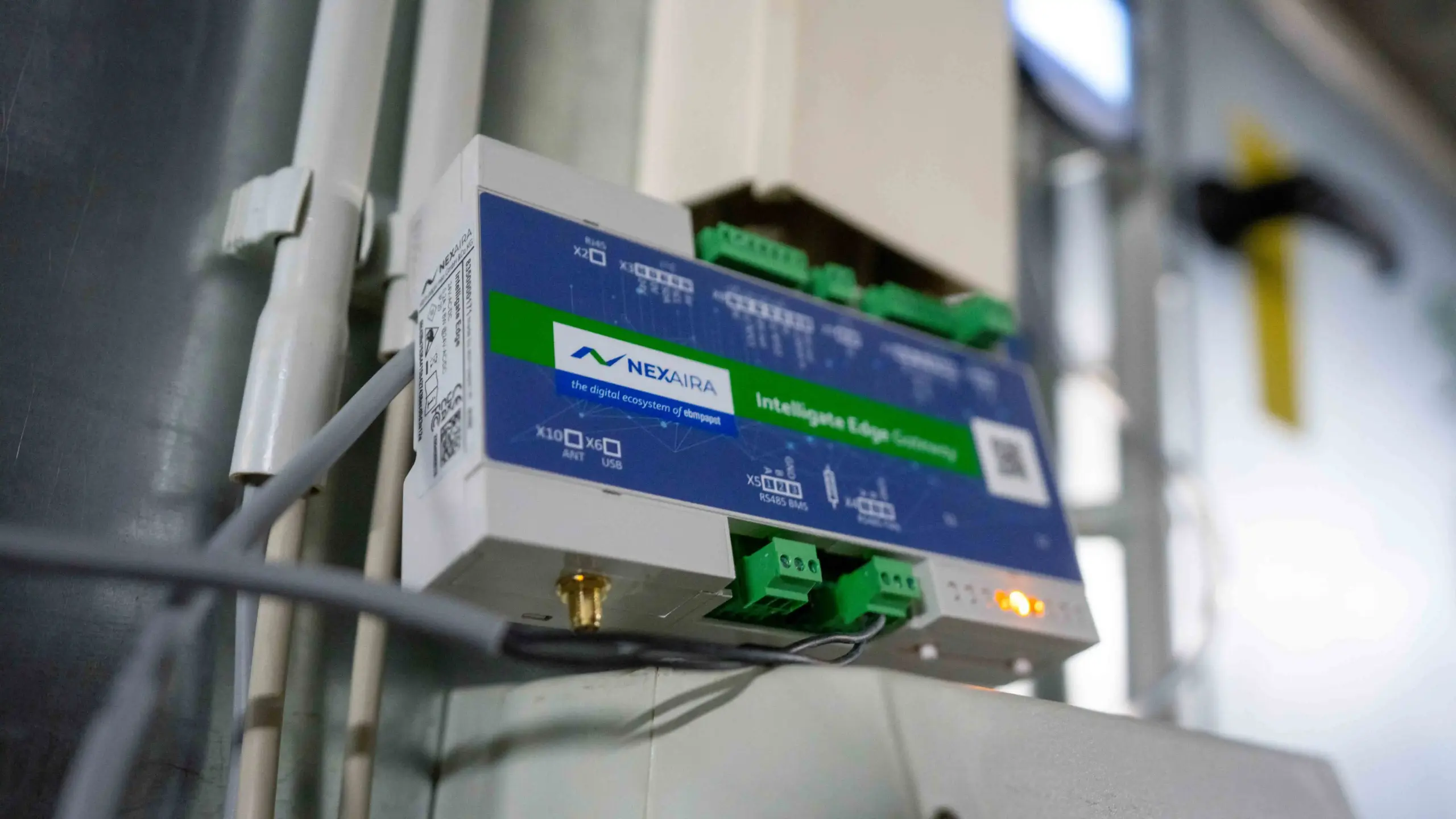
One sensor in each system also measures the differential pressure across the filter. This allows NEXAIRA to detect when a filter becomes clogged and the fans need to increase their output. In addition to detecting filter clogging, NEXAIRA offers other digital services: “Fan Health Status” assesses the condition of the fans and provides an estimate of their expected service life, and monitoring, alerts and heat maps show how the system is performing and where deviations occur. This allows the system to detect malfunctions earlier, supports targeted maintenance and ensures the systems operate efficiently.
Less energy, more visibility
The retrofit is paying off. The new fans consume about 40 percent less energy than the old equipment. In addition, digital monitoring provides greater transparency into ongoing operations. The technical team can now assess system conditions more easily and identify potential optimizations more rapidly.
approx. 0%
energy savings
approx. 0-year
payback period
The payback period is also only around two years. For Klaus Uetrecht, it is precisely this combination that is crucial. “For us, operational reliability is clearly the top priority,” he says. “Of course, the fact that the modernization pays for itself through energy savings makes the project all the more worthwhile.”
For the Green Team and the technical department, the kitchen ventilation system is an important first step toward more efficient building services. This is why the retrofit in the hospital kitchen won’t be their last project. Klaus Uetrecht and his team are already evaluating other systems and determining the optimal sequence for modernization. In this way, this rapid solution for the hospital kitchen is becoming a model for other systems in the building.
Leave a comment