
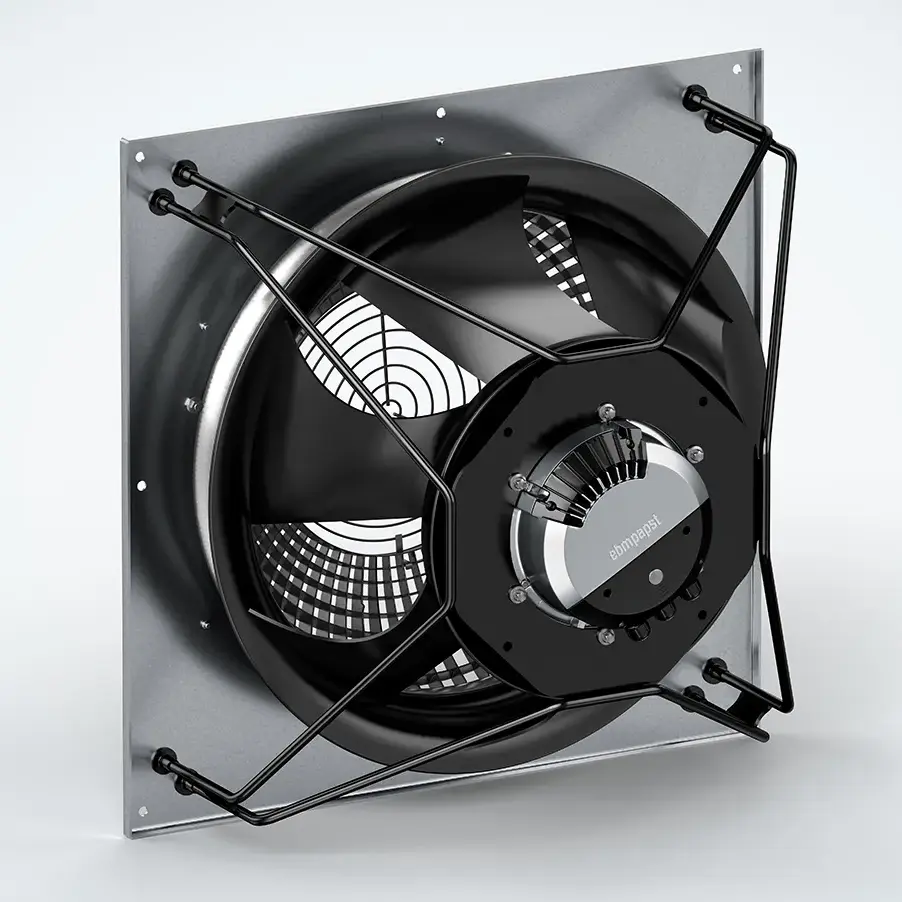
The new RadiFlow 630
The radial fan for limited installation space, low operating costs, and greater system efficiency.
Air exchange is the foundation for an optimal indoor climate for people and for cooling electronics. It replaces stale air in buildings open to the public and removes large amounts of waste heat from data centers or production facilities. In both cases, large airflows must be moved as efficiently as possible. The fan specialists at ebm-papst have developed a new fan design for such tasks that moves large volumes of air at high efficiency in compact spaces, offering many advantages for manufacturers of modern HVAC and ventilation equipment. The fan enables high power density and low-turbulence operation in FanGrids, even in tight air ducts.
Optimized composite impeller geometry
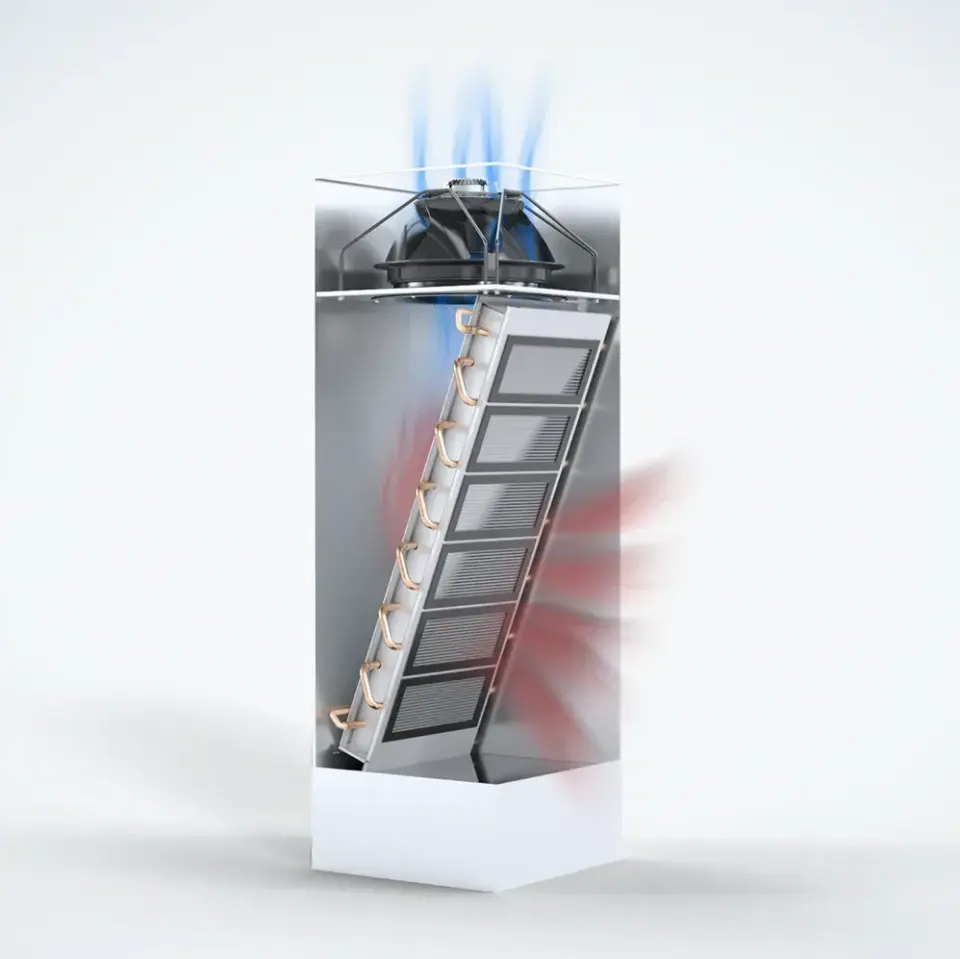
Air conditioning is a major cost factor when considering the operating costs of large buildings, data centers or production facilities. Since fans in these buildings operate 24/7, investments in more efficient components quickly pay off. Such applications typically operate at low to medium back pressure and need to be as compact as possible (Figure 1). The new RadiFlow fan with a 630 mm diameter is therefore equipped with a flow-optimized impeller (Figure 2) that tolerates high peripheral speeds.
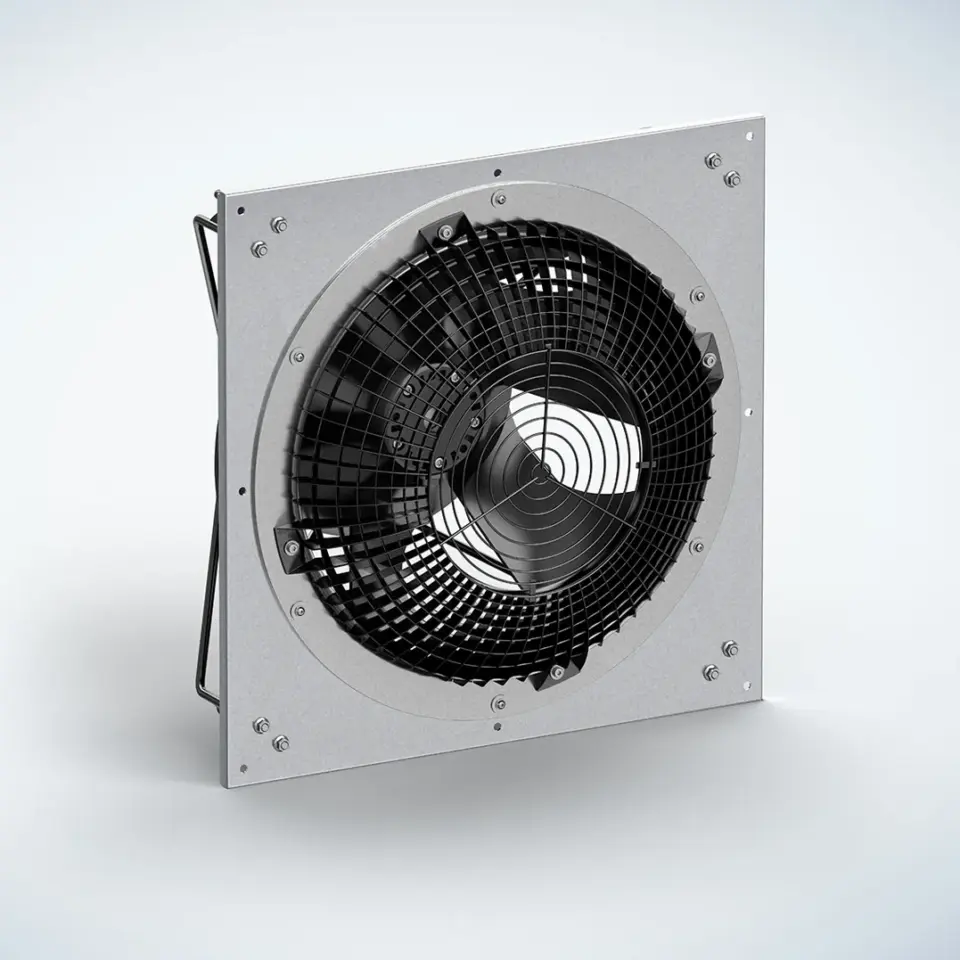
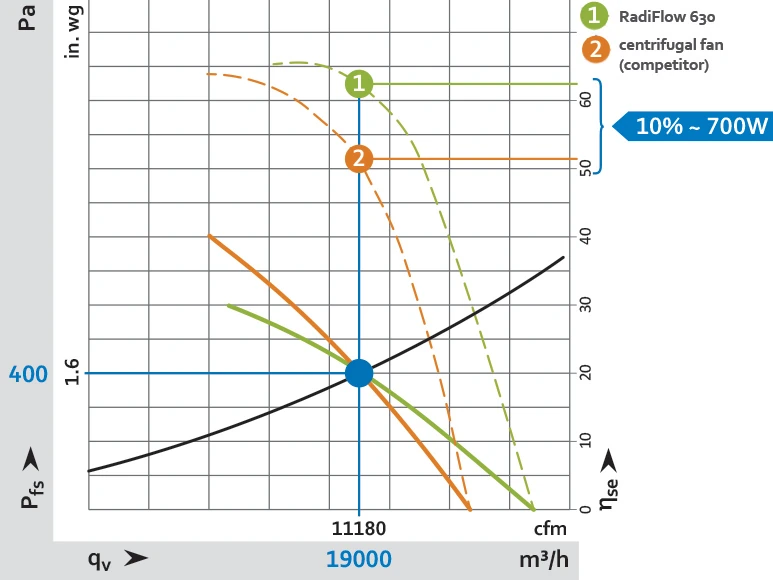
A high-strength, glass-fiber-reinforced composite material was used, with the complex shaping made possible through an injection molding process. This blade geometry drastically reduces flow losses. Based on modern manufacturing processes, the impeller has been significantly improved, and a diagonal 6-blade design has been developed that ensures axial flow. At its optimal operating point, the RadiFlow 630 achieves up to 10% higher efficiency in the application compared to the market standard (Figure 3).
Compact and quiet
The RadiFlow truly shines in compact ventilation units. When comparing the performance of the RadiFlow in an installed state with that of conventional centrifugal fans, it delivers the full air volume without any loss of performance when installed in a 910×910 mm ventilation box, whereas other centrifugal fans require performance adjustments in this confined installation space. For a 2×2 FanGrid with four fans, this translates to a space saving of up to 40% (Figure 4). The overall length is also significantly shorter. The highly efficient EC motor is integrated into the impeller in such a way that 30 to 100 mm less space is required. To ensure quiet operation, the motor suspension was designed as a spider-like structure.
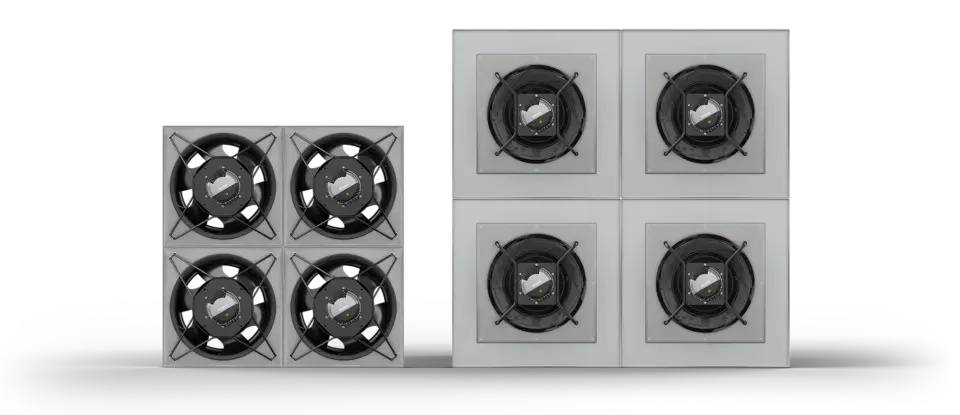
Figure 4a: Thanks to this unique design, the RadiFlow is extremely compact, allowing 2×2 FanGrids to be up to 40% smaller, for example. (Image | ebm-papst)
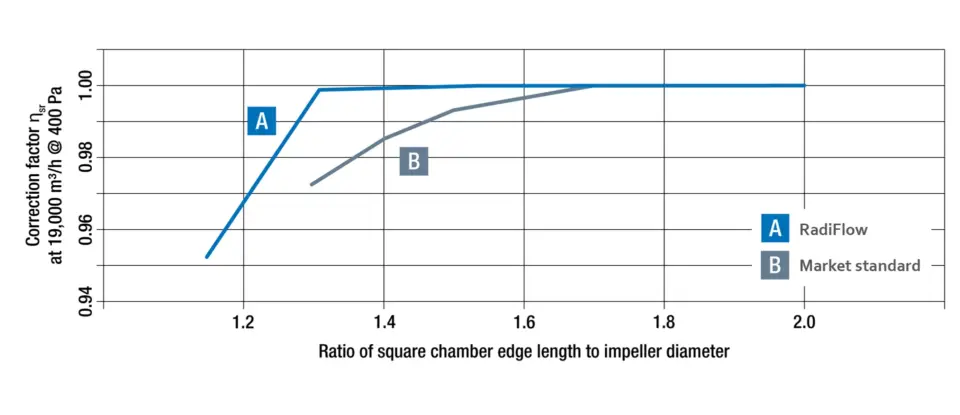
Figure 4b: The new RadiFlow fans are suitable for tight installation spaces. The correction factors are based on internal measurement series conducted with various outlet cross-sections. (Image | ebm-papst)
The eight struts were precisely adapted to the impeller geometry and distribute force across four mounting points (Figure 5). An integrated resonance detection system in the motor electronics identifies installation-specific resonance ranges during the ramp-up to rated speed. These speeds can be specifically avoided or quickly by-passed during subsequent operation. This protects the bearings, increases operational reliability and prevents premature failure of the fan.
Active “power factor correction” minimizes grid disturbances
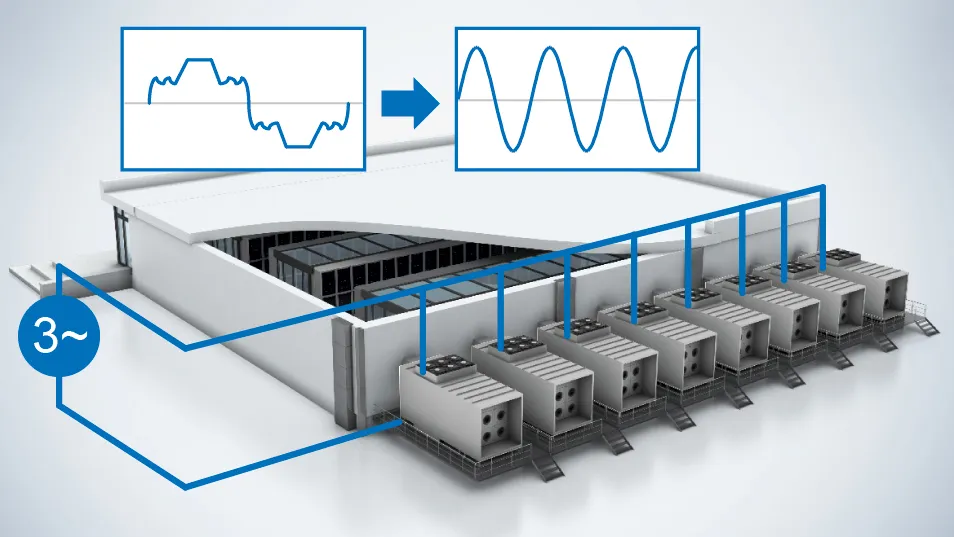
Speed control is essential for demand-based air conditioning. However, speed-controlled drives inherently generate electrical harmonics during operation. When combined with an undersized power supply, these can cause problems in critical infrastructure. The resulting harmonics place a greater load on the power grid and cause losses due to reactive power. Additionally, other devices in the system network can be negatively affected. For the operator, this means the necessity of installing external filters, ensuring adequate reactive power compensation and possibly using larger cable cross-sections.

Power quality under control – no extra effort required!
Discover in the white paper how integrated active rectification makes EC fans ready for the toughest requirements.
To minimize disruptive harmonics during parallel operation of EC fans, ebm-papst has spent several years now developing a solution—the Active PFC (Power Factor Correction)—in which the harmonic filter is already integrated, rendering such external measures unnecessary (Figure 6). Active PFC takes the approach of preventing current harmonics from arising in the first place, rather than laboriously filtering them out afterward with additional components. As a result, infrastructure components for power and emergency power supply—such as transformers and emergency power generators—can be designed to be smaller and thus more cost-effective. The values achievable with Active PFC are impressive: The power factor is over 0.99, the THD(I) is typically around 2% at rated power and remains below 5% even when reduced to 10% of rated power. THD(I) stands for Total Harmonic Distortion of Current and indicates the extent of current distortion.
Efficient, networked and future-proof
RadiFlow fans are available with rated power outputs of 4 and 8 kW with passive PFC, as well as 4 and 7 kW with active PFC. They can be controlled via either 0-10 VDC or MODBUS RTU and are equipped with integrated EMC filters. They comply with relevant EU directives as well as international certifications such as UL. Additionally, external sensors can be integrated into the fan control system and used for remote monitoring functions. By avoiding the use of critical materials such as rare-earth magnets, the fans conserve resources and offer not only reliable operation but also environmental friendliness throughout their entire lifecycle.
Leave a comment