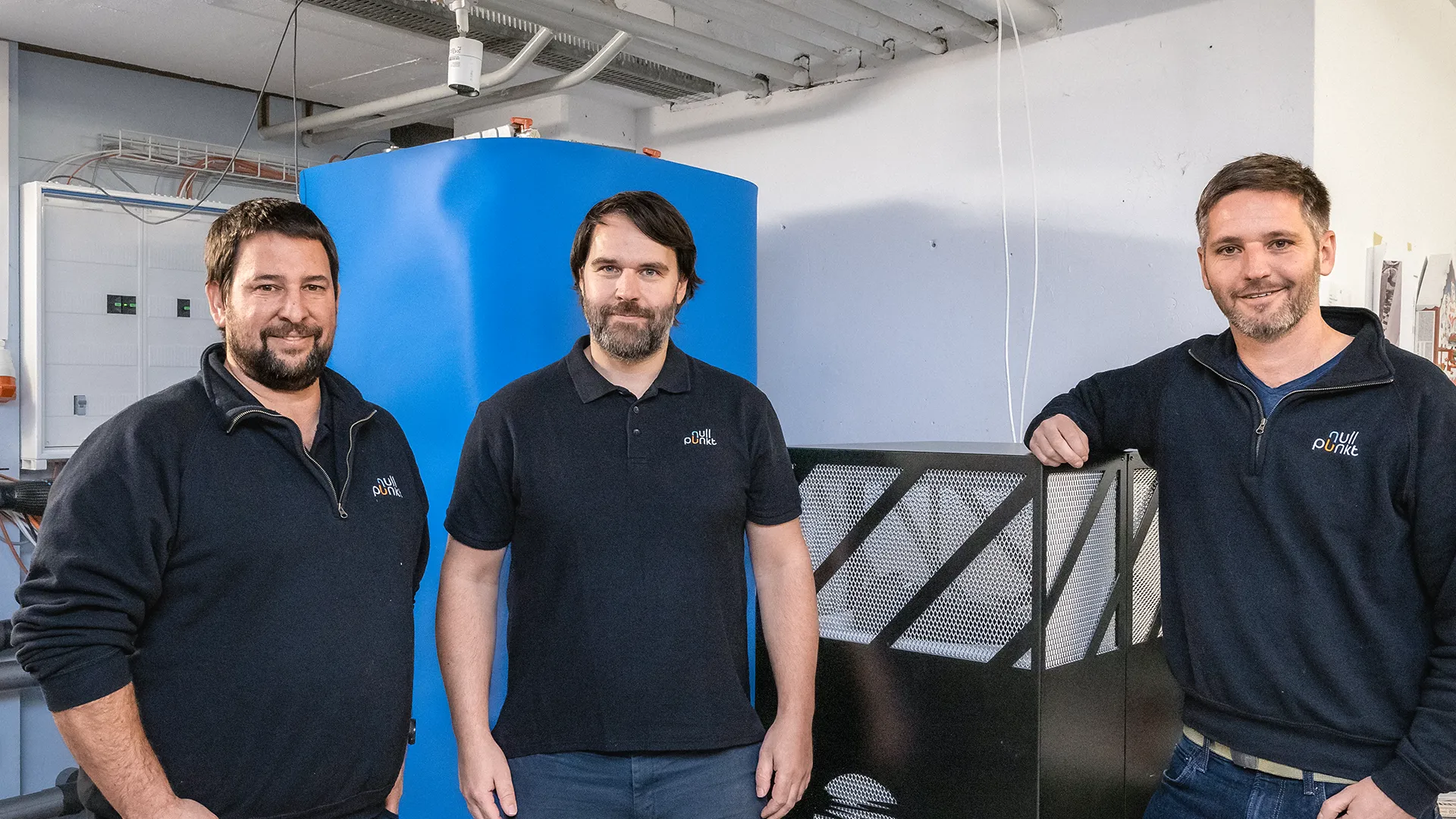
On the workbench in a Swiss garage lie an engine cooling system, a self-bent composite pipe heat exchanger, the hoses of an antifreeze circuit—and an ebm-papst fan. A water tank stands on the floor. Cable ties, tools and an old brine heat pump complete the makeshift setup. Thomas Degelo, Michael Egli and Pascal Barmet sit around it, tinkering, discussing and forging a plan. “We asked ourselves why there was no system that provided renewable heating without going deep into the ground or installing a lot of technology outside. That’s how the idea of implementing the principle of an ice storage heat pump on a small scale came about,” says Thomas Degelo.
From a Garage Start-Up to a Full-Fledged Company
Traditional ice storage heat pumps are suitable for large buildings: hotels, office complexes, or commercial buildings. This is because they use large, underground concrete tanks that hold several thousand liters of water. Heat exchangers are located inside these tanks, through which heat from renewable energy sources is fed into the system. When heat energy is extracted from the storage tank, the temperature drops to 0° Celsius; the water freezes, releasing energy that is used for heating. When heat is reintroduced, the ice melts again, and the cycle begins anew. Ice storage heat pumps are designed for seasonal storage management: heat is stored in the summer and retrieved in the winter.
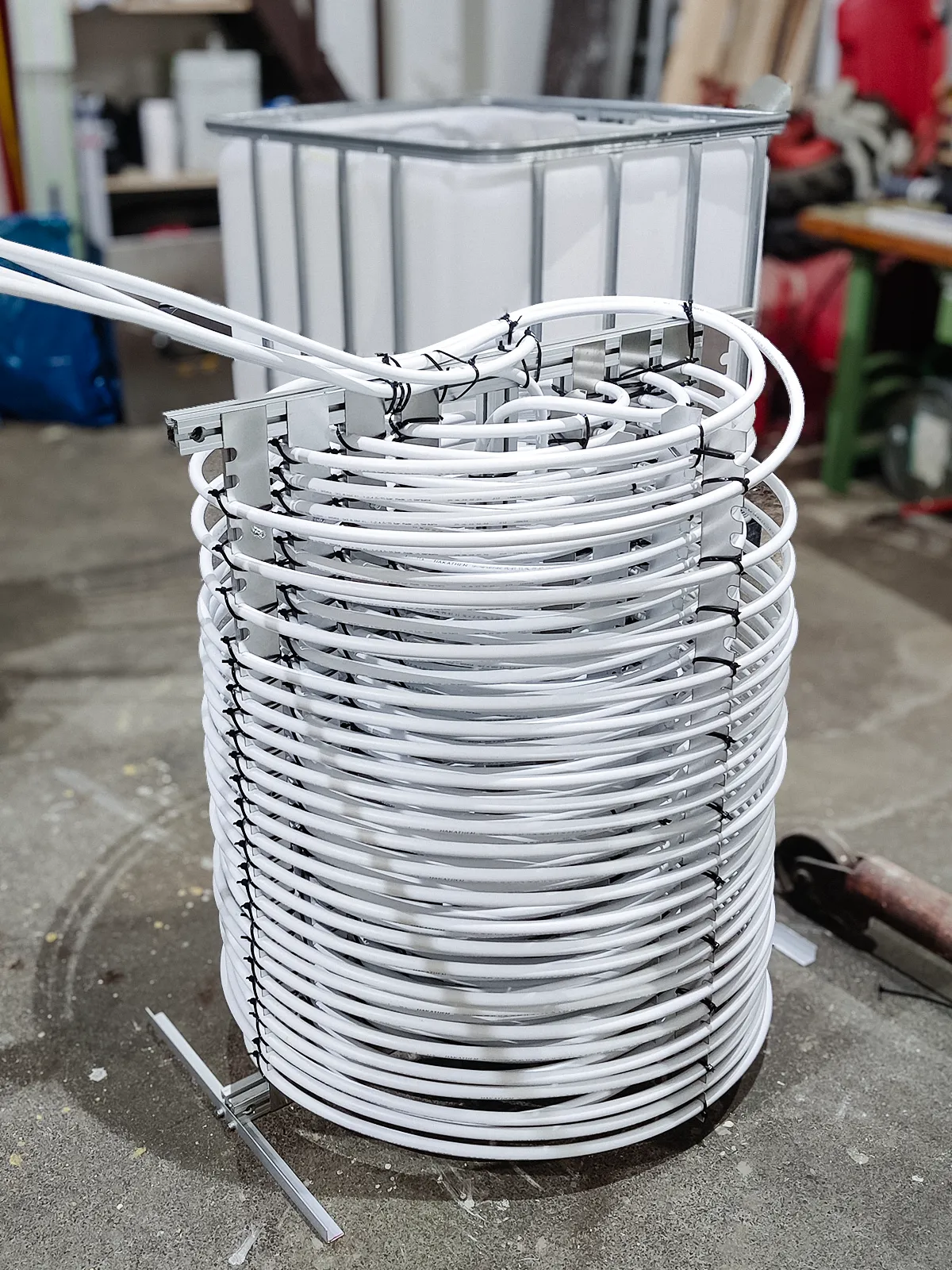
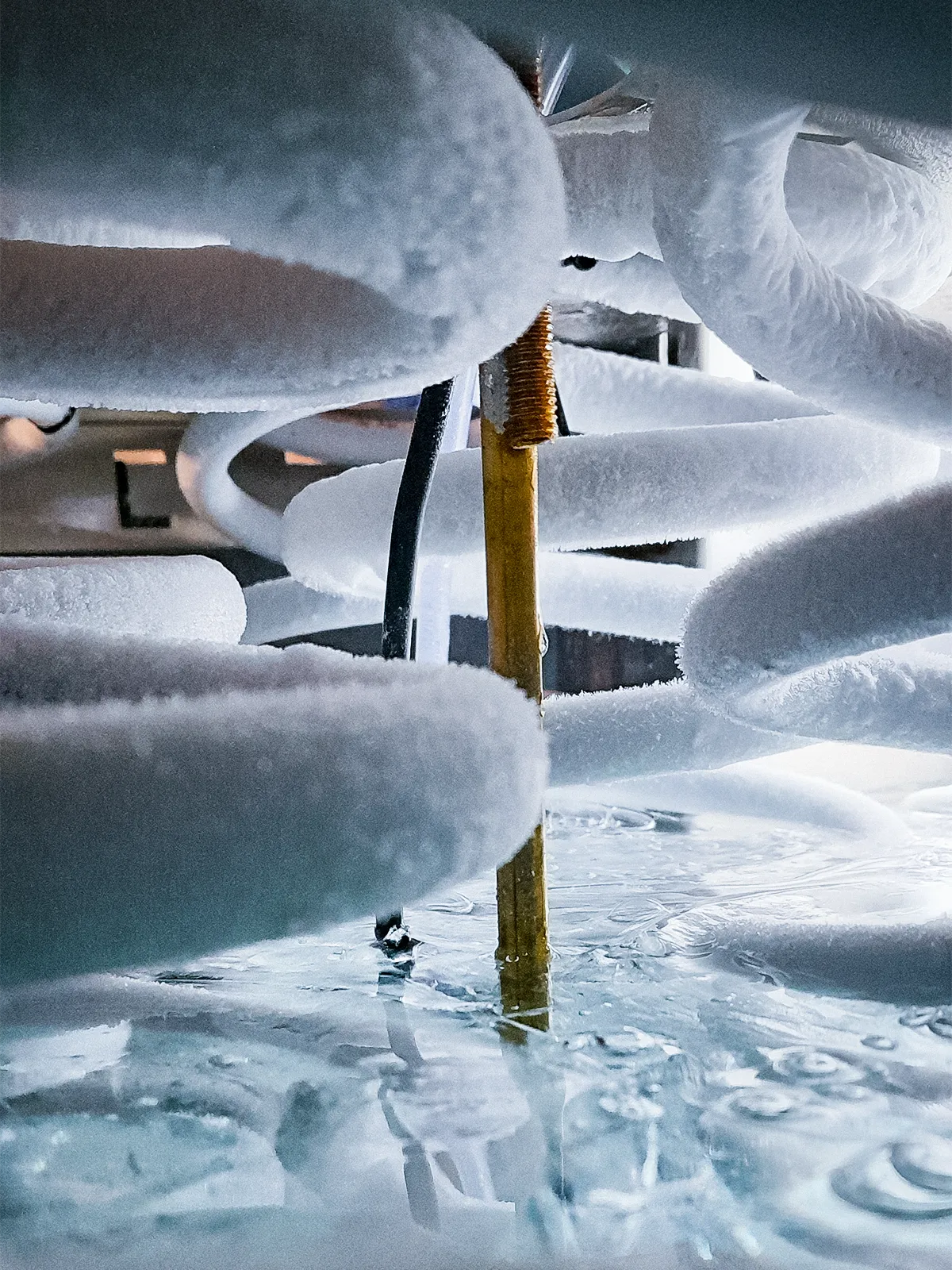
The heat transfer fluid flows through the heat exchanger coils and absorbs energy from the ice storage tank. (Images | Nullpunkt AG)
For a single-family home, a typical system like this is too large, too expensive, and far too complex. But conventional heat pumps also have their limitations: ground-source heat exchangers require permits, involve extensive construction work, and are costly. Outdoor air-to-water heat pumps take up space, require careful noise and site planning, and are not to everyone’s aesthetic taste. “As the three engineers and homeowners that we are, we weren’t willing to accept that,” says Degelo. “We asked ourselves why there wasn’t a system that provides renewable heating without going deep into the ground or installing a lot of equipment outside.” That’s how the idea arose to develop an ice storage heating system that could also fit in a garage, a basement room, or a niche.
In the winter of 2023, the three engineers installed the first prototype of a compact ice storage heat pump at a colleague’s house. The oil heating system remained connected as a backup, just in case. But the improvised setup consisting of car radiators, composite pipes, antifreeze solution and an old fan worked—and was surprisingly stable at that.
The successful experiment marked the starting point: Development of the ice storage heat pump began in 2023, and in 2025 the engineers founded nullpunkt AG—with the goal of developing a marketable ice storage heat pump for single-family homes.
How does Triton work?
Triton consists of three components: a brine-water heat pump, a compact ice storage tank holding approximately 1,000 liters of water, and an outdoor heat exchanger that transfers energy from the ambient air into the storage tank. Instead of storing heat seasonally like traditional ice storage systems, Triton operates on a daily cycle: At night, the heat pump extracts energy from the storage tank. This causes the water to freeze, and the released heat is used for heating. During the day and in warmer weather, environmental heat is fed back into the storage tank via the outdoor heat exchanger, causing the ice to melt and the cycle to start over. The basis for this lies in what is known as latent heat: When heat energy is extracted from water, it cools down to 0° Celsius; after that, heat energy can continue to be extracted without the water getting any colder—it then freezes and remains at 0° Celsius. Since the storage tank is regenerated entirely via the ambient air, the system requires neither ground-source heat exchangers nor solar thermal energy. This makes Triton easy to install and suitable for use even in densely built-up residential areas.
Winter in summer?
But then winter was over—and with it, the real-world conditions needed for a true stress test. The three engineers didn’t want to wait for the next one. So they simply recreated it: In a rented underground parking garage, they set up their own climate lab—complete with a cooling system, humidification, and a control system capable of generating frost and fog profiles at the push of a button. “We were able to bring the chamber down to minus 15 degrees Celsius and 90 percent humidity,” says Degelo. “This allowed us to specifically test situations that rarely occur together outdoors—and certainly not when you need them.” A year later, Nullpunkt installed the further-developed prototype at their colleague’s facility again. It was an exceptionally cold winter with plenty of freezing rain—the perfect endurance test. Based on these tests, Nullpunkt made final adjustments. The start of series production was now within reach, but one crucial component was still missing.

At night, Triton is barely audible compared to other heat pumps on the market—we owe this largely to this fan.
Thomas Degelo, CEO Nullpunkt AG
The very first prototype ran on an old ebm-papst fan that was originally intended for another project by Degelo’s engineering firm. Its purpose was to convey the ambient air through the external heat exchanger and thus regenerate the ice storage tank. “I was already familiar with ebm-papst from my time in building services engineering, so I know how efficient their products are,” says Degelo.
The AxiTone is unbeatably quiet
As development progressed and the team needed a new, more efficient and significantly quieter fan, nullpunkt contacted ebm-papst in Switzerland. Samuel Schlittler, sales representative at ebm-papst in Switzerland, quickly came up with the right suggestion: the AxiTone, an axial fan specially developed for heat pumps with particularly quiet operation.
In the heat pump’s ice storage tank, water freezes when heat is extracted and melts again when energy is supplied. (Video | Nullpunkt AG)
“The 450 mm AxiTone fits into the Triton concept without any major adjustments. It delivers the necessary airflow while remaining highly efficient—and, above all, quiet,” explains Schlittler. During the day, the noise level is around 53 dB(A), and at night it drops to as low as 35 dB(A). In conventional heat pumps, the air usually flows in from the side. In Triton, the AxiTone is located on top of the outdoor unit and pushes the air down through the ring-shaped heat exchanger. This air flow ensures an even flow through the heat exchanger and contributes significantly to the low noise level. “The AxiTone offers enormous advantages for us,” says Degelo. “At night, Triton is barely audible compared to other heat pumps on the market—we owe this largely to this fan.”
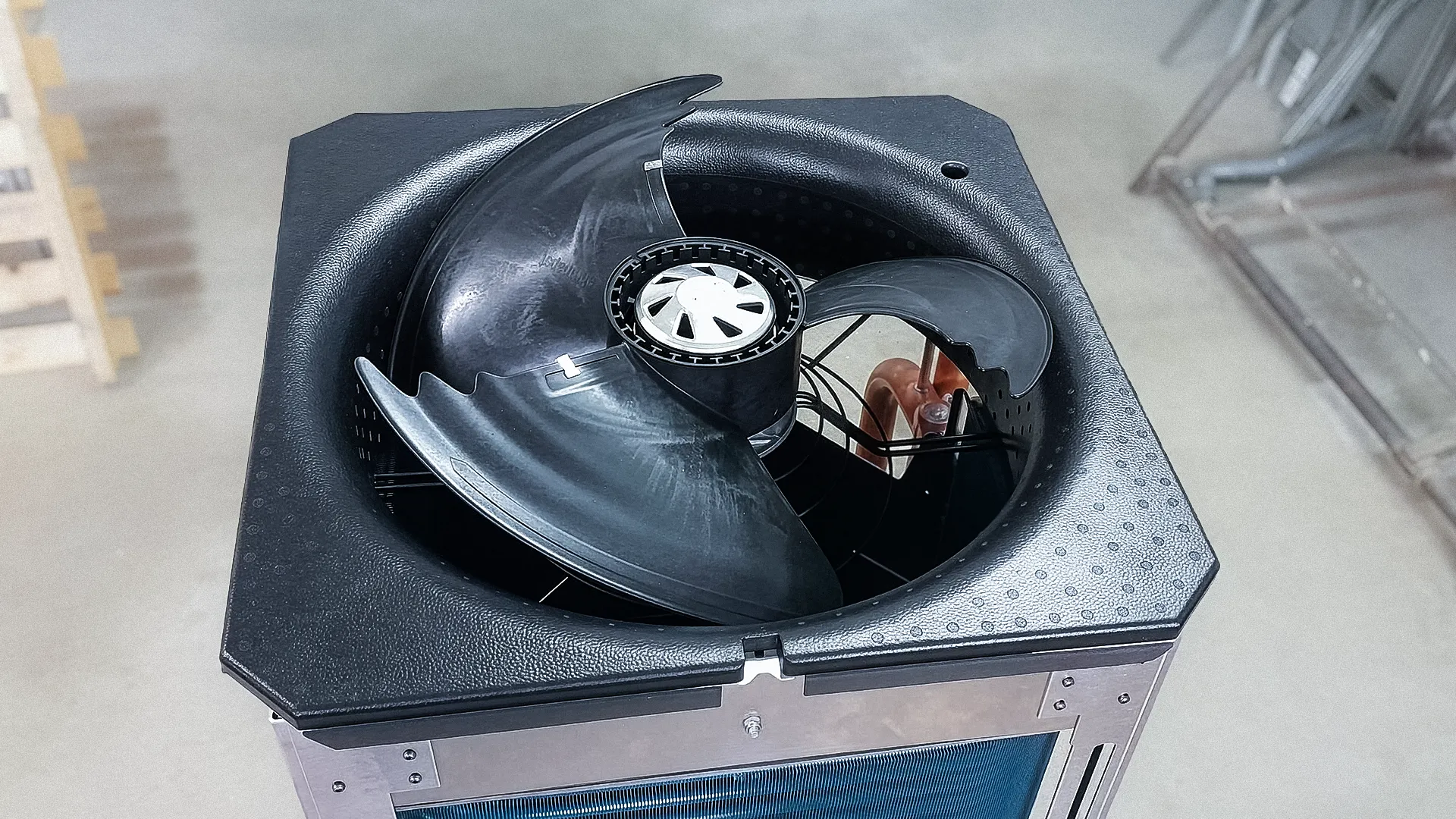
In addition, the flow technology experts at ebm-papst in Mulfingen contributed their expertise to the further development: Together, the partners optimized the entire air flow, adjusted the baffles, refined the heat exchanger geometry and coordinated the flow paths with each other. The result is an outdoor unit with particularly quiet running characteristics and high efficiency.
A start-up that is rethinking heating
The Triton system has been on the market since October 2025 and the first systems have already been installed. At the same time, the company is already planning the next step: The heat pump will also be launched on the German market. Although Triton does not require any additional heat sources, nullpunkt is planning extensions such as the integration of photovoltaics or waste water heat in order to further increase efficiency and the use of self-generated electricity.
Leave a comment