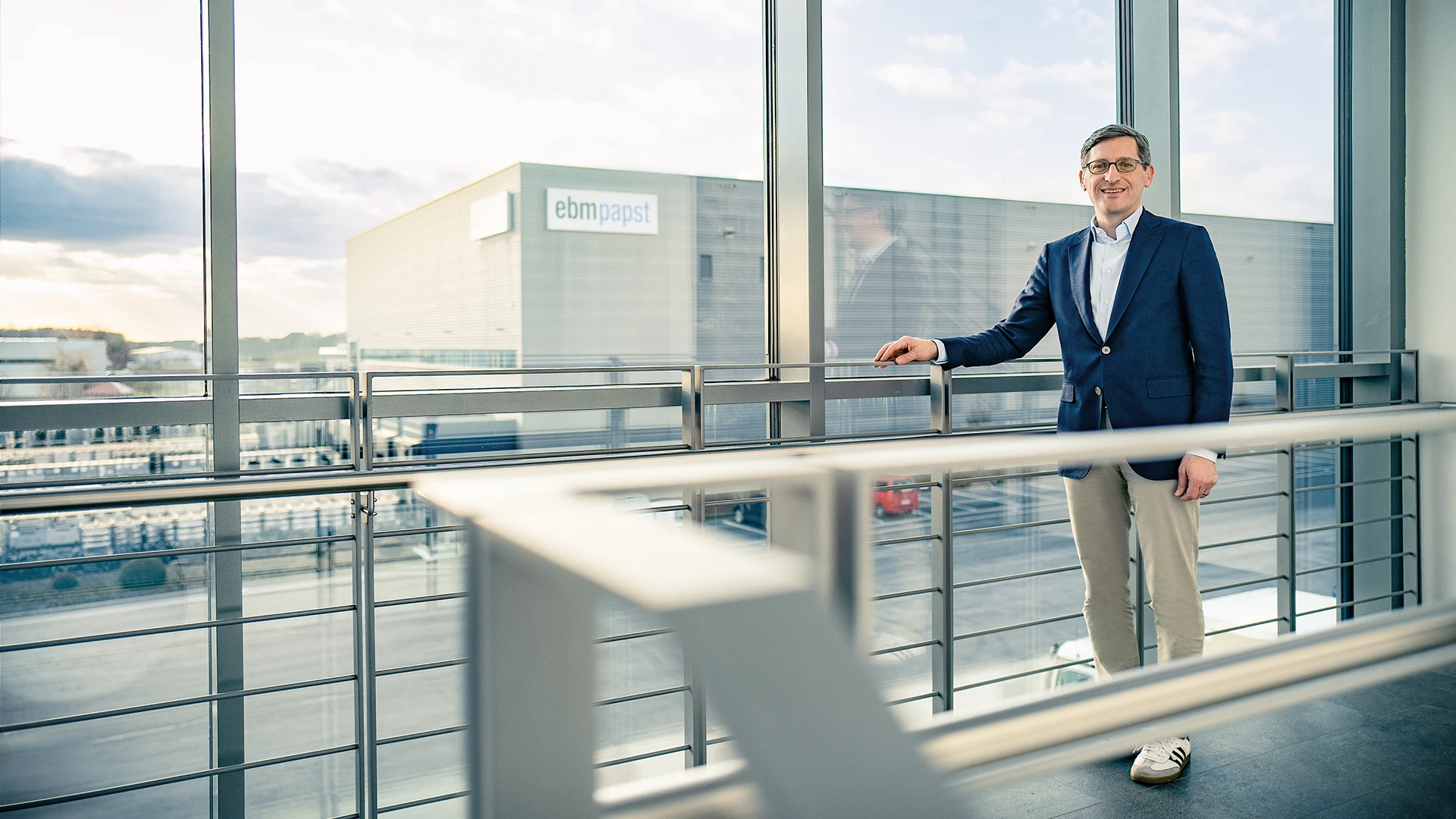
Mr. Geißdörfer, we are currently in the midst of multiple crises at once, from war in Ukraine to a sluggish economy and turbulent transatlantic relations. How do you deal with all this?
In times like this, it’s important to stay calm. I deliberately only check the news once a day and give myself two or three days to sort the topics in my head. In my role I can’t act abruptly; I have to keep a cool head and make long-term decisions.
How is ebm-papst currently doing from a financial perspective?
Our business is once again on a positive trajectory, which tells me that we set the right strategic course early on. The transformation is now bearing fruit. Our “local-for-local” strategy, which we launched some years ago, is a big help here as our focus on localization has made us more resilient today. That’s a good feeling, but we cannot rest on our laurels – we have to keep moving forward. Shifts in the geopolitical landscape mean we are facing new challenges – for example, because end markets are shifting from Europe to Asia and the USA. This directly impacts our capacity utilization in Europe, and we’re working out how best to use this available volume strategically.
You mentioned the transformation – how well does your strategy still suit the current situation?
Very well. We made the right decisions three years ago; our move away from the automotive segment has proven to be the correct course of action. We’ve now halved our volume of business here and are currently working on fulfilling our remaining obligations to our customers. The sale of the Drive Technology division is a “win-win-win” situation for everyone involved. The division can grow much better under Siemens. Our focus on our core competencies in ventilation and heating technology will really drive us forward.

Many companies are cutting back in the crisis – but you’re investing. Why is this?
Because we firmly believe we’re on the right course. We’re focusing on future issues and building up local resilience. We’re making targeted investments in promising markets such as data centers, in expanding our innovations, and in new technologies. Examples include the HighSpeed Technical Center and the E-Drive Solution Lab. As a result, we’re currently launching new products like never before. Our innovation pipeline is chock-full once again. While I’d prefer us to be even faster in our implementation, we’re on a very good path.
What are you focusing on with the technologies?
We look at the entire product life cycle. The aim is to speed up development, supply more energy-efficient products, further sharpen our competitive edge in technology, and in doing so lead air technology into a new era. The best proof of this is NEXAIRA, our digital ecosystem. The first concrete customer projects are already underway here, and we’re receiving very good feedback. But we’re not neglecting our traditional markets and are, of course, also launching new, strong products here: intelligent high-efficiency fans.
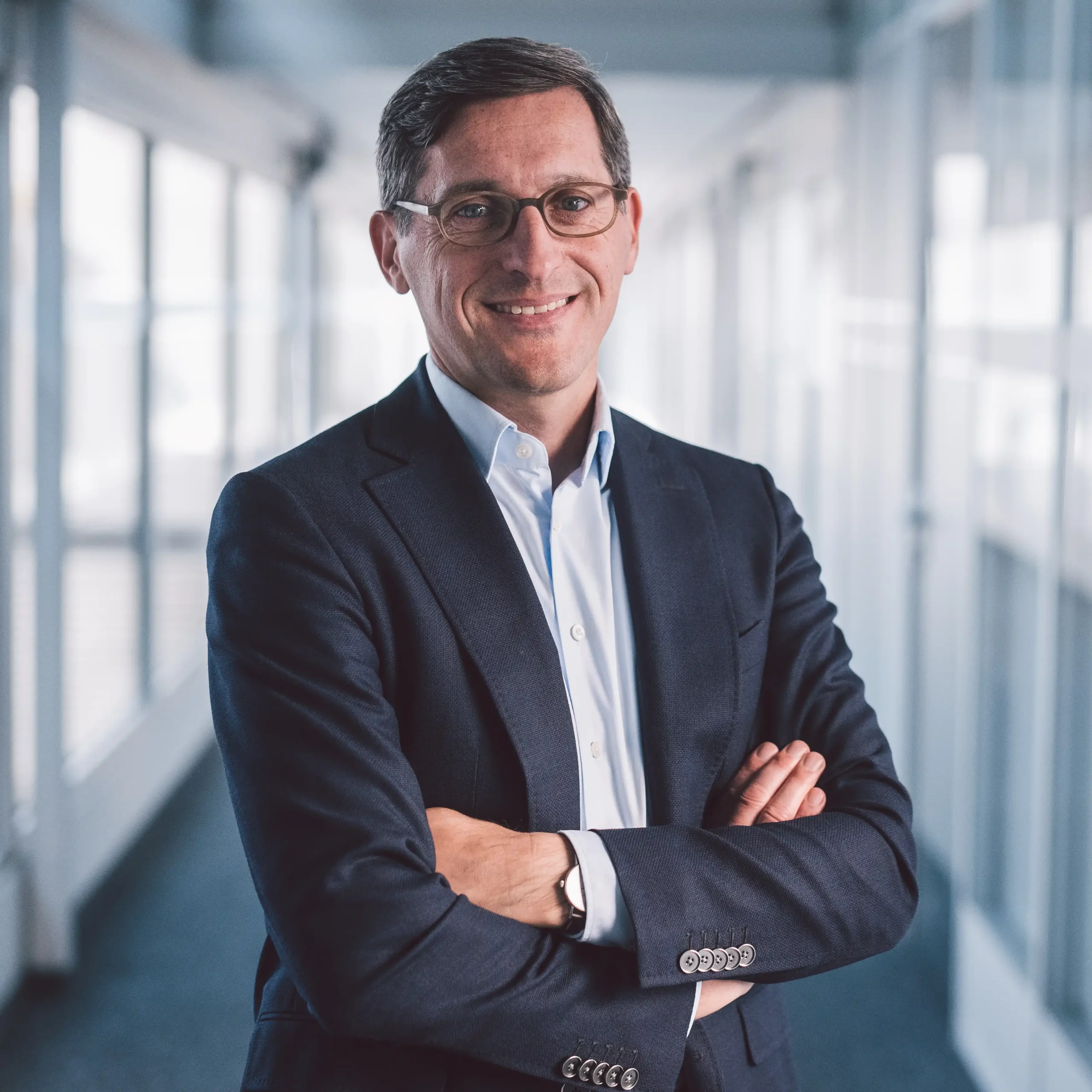
If you want to drive forward innovation, you have to take the first step – and we see ourselves as a partner on this journey.
Klaus Geißdörfer, CEO ebm-papst Group
Given the way global trade is at the moment, is your early focus on glocalization now paying off?
Definitely. Geopolitical developments have made our local-for-local strategy even more important. That’s why we’re building new plants, such as in Oradea in Romania, Xi’an in China, and Chennai in India. We’re gaining market share in Asia and are working at the limits of our capacity in the USA. In Europe, too, we’re working to full capacity in the data center segment and are expanding capacity. Unfortunately, in the heat pump segment we’re still feeling the repercussions of the German Building Energy Act (Gebäudeenergiegesetz). And in the residential ventilation segment, we’ve not yet been able to compensate for the market decline in the construction sector. However, our innovations mean we’re in a position to gain market share again here as well.
What’s next in terms of the regions – what areas will you focus on in future?
We’re developing well in Asia, so now the next logical step is the USA, where we’re planning to set up additional local production capacity. For our customers, this means faster deliveries, reliable supply chains, and more efficient products on the market.
Let’s turn to another hot topic: artificial intelligence. How is ebm-papst positioned in this respect?
AI is an issue that is crucial to our future. We’re deploying it selectively in our products to optimize energy consumption and further increase reliability, and we’re also using it for process control, in Knowledge Management, communications, and beyond. We’re giving our staff comprehensive, practical training on it. AI is not a stand-alone project – it runs through our entire organization.
You’re also involved in the Innovation Park Artificial Intelligence (IPAI) in Heilbronn. What specific benefits does it bring?
The IPAI gives us access to experts, talented people, and a strong network. For example, we’re collaborating with Bechtle AG on generative AI, and it also helps us with overarching issues such as ensuring legally watertight applications or system architectures. It’s a real stroke of luck to have this type of AI center right on our doorstep.
I firmly believe that Europe currently has a historic opportunity. With AI and digitalization, we can regain a leading position as long as we pool our strengths.
Klaus Geißdörfer, CEO ebm-papst Group
How is it benefiting your customers?
Our products are becoming more intelligent and energy-efficient, which significantly reduces energy consumption at the customer’s premises. Digitalization means we can speed up the development cycle and offer new services, including all-digital ones. As you can see with NEXAIRA, this has long since ceased to be just a vision of the future – our customers are already benefiting from it today.
And if you could request something from your customers, what would that be?
More courage, particularly when it comes to trying out new technologies. Many are still hesitant – they’re worried they’ll tie themselves to us too much, or they ask themselves whether the innovations really work and make the difference they claim to. We’re seeing that customers who get on board early on have a competitive edge and are the most successful ones today. If you want to drive forward innovation, you have to take the first step – and we see ourselves as a partner on this journey.
Is there anything that’s particularly important to you beyond all these issues?
Yes. I firmly believe that Europe currently has a historic opportunity. With AI and digitalization, we can regain a leading position as long as we pool our strengths: excellent research, great talent, strong values. We need to translate our expertise into products and business models. This requires courage, collaboration, and a resolute determination to position Europe as the third global force alongside the USA and China.
Many people have reservations about AI. What would you say to them?
Fear of new technology is understandable, and it’s nothing new if we look back at history. The important thing is to use AI responsibly. Yes, there’s a risk of misuse, such as from deepfakes or in consumer manipulation. But at our company, we’re using AI selectively and ethically in products and processes. We don’t need fear, we need expertise, responsibility, and a willingness to actively shape this new technology.
Leave a comment