
Building a new car factory involves far more than simply housing large production lines under one roof. Both people and machines need the right working conditions — above all, fresh air and comfortable temperatures. Ventilation and air conditioning systems in the production halls ensure the quality of the air. But which fan technology should these air handling units (AHUs) use — AC or EC? A Korean automotive manufacturer faced this question while planning its electric vehicle plant. The requirement: Modern electric vehicles also need a modern and energy-efficient production facility.


AC Technology: Only Cheap at First Glance
AHUs for a new electric car factory? That sounds like a case for EC technology. But the original request for proposals called for locally manufactured AC fans — a technology the automotive manufacturer has traditionally relied on. And this is no exception in Korea: AC fans and belt-driven systems are widely used there, have a proven track record, and are cheaper to purchase. But the truth is also that AC fans consume significantly more electricity for the same output. This makes the technology more expensive in the long run — especially as energy prices rise worldwide. Therefore, simply looking at the data sheet was not the deciding factor.
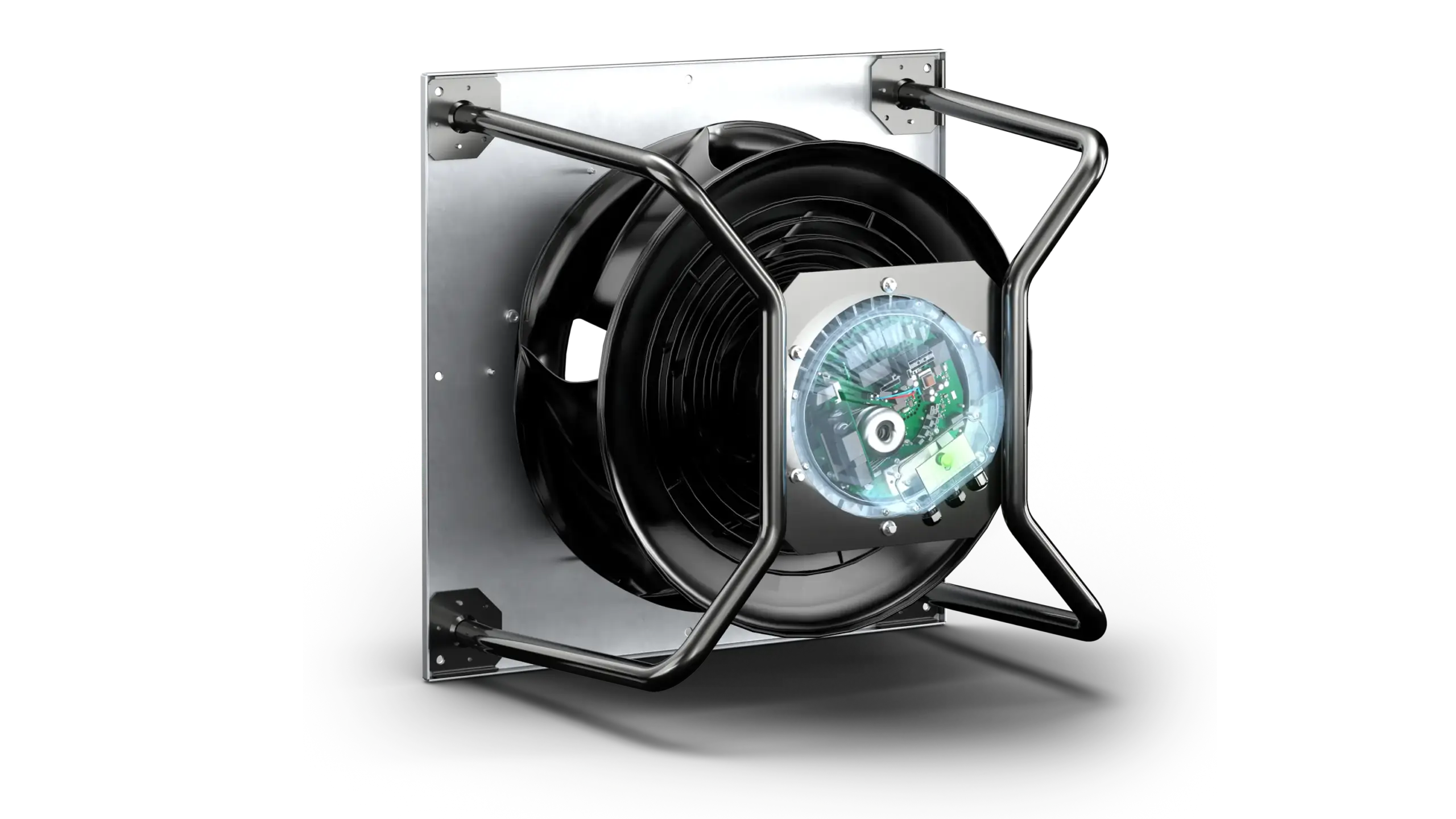
The Korean equipment manufacturer Cheong Nam Air Conditioner Inc. entered the bidding process with a revised AHU solution. Instead of the AC fans originally specified, the company opted for efficient EC technology from ebm-papst — and was awarded the contract. A total of 52 RadiPac 3C units were selected for the AHUs. On both the supply and return air sides, they are arranged in a FanGrid configuration.
0
RadiPac 3C
fans
0
FanGrid systems for supply and return air
EC technology that pays off
But what makes the RadiPac 3C so efficient? Several factors work together: The EC motor ensures energy-efficient operation, the optimized aerodynamics keep flow losses low, and the speed can be continuously adjusted to current demand via Modbus. Instead of running continuously at full power, the fan delivers only as much air as is currently needed in the production halls. Thanks to its low-vibration design, it also remains pleasantly quiet. The compact design of the EC centrifugal fan is a further attractive attribute: The impeller, motor, and electronics form a ready-to-install unit that takes up very little space in the AHUs.


Commissioning is also straightforward and requires no complex programming. The brushless motor and integrated protection functions against overheating and vibrations also contribute to low-maintenance and reliable operation. What costs more initially is cheaper and safer in the long run. And there’s even more potential when it comes to energy efficiency. Digital solutions like NEXAIRA.Core can complement the RadiPac 3C — for example, when it comes to monitoring or AI-powered analytics. For the automotive manufacturer, the decision to adopt EC technology therefore pays off twice over. It saves energy and money today and its air handling units can be expanded in the future. In this way the future of mobility at the Ulsan plant doesn’t just begin on the assembly line — it starts with the air flowing through the production halls.
Leave a comment