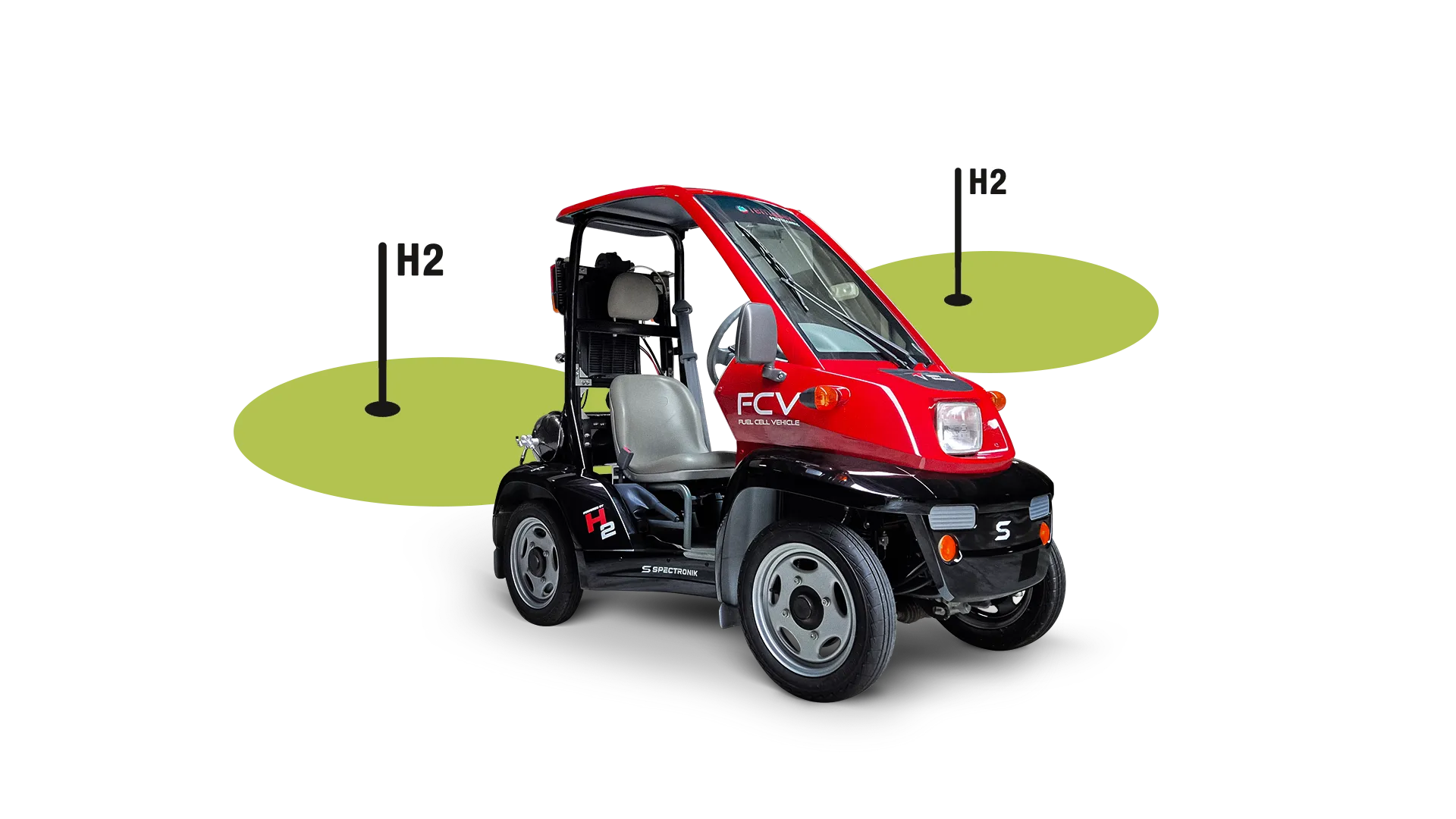
The morning sun is still low over the green as the electric golf cart rolls silently away from the clubhouse. It shuttles back and forth between tees and fairways on the sprawling course. However, its range is limited: By noon at the latest, the battery is empty and the cart has to be plugged into the charging station for several hours. This is a typical problem for small electric vehicles.
The reason is simply the low energy density of the battery: Although it is small and light, it stores only a small amount of energy. In addition, the battery cannot be charged as quickly as desired because it would otherwise overheat. A larger battery does not solve the problem either: It only makes the vehicle heavier and thus more energy-hungry. Small, mobile applications therefore need a different energy source that enables greater range, can be recharged more quickly and remains emission-free.

The democratization of fuel cells
This is exactly where Spectronik comes in. The Singapore-based company specializes in compact hydrogen fuel cells. The company’s stated goal is to further develop and democratize a technology that, due to its complex design, has so far been reserved for large applications such as trucks and buses.
With its Protium series, the company has managed to greatly compress the technology. The result: a lot of energy in a small space with low weight. In addition, the cells can be refueled in a few minutes and are completely emission-free during operation. Finally, when hydrogen reacts with oxygen, the only waste product besides energy is water. Spectronik is thus opening up the technology to completely new applications for which hydrogen fuel cells were previously too large or too heavy. However, compactness also brings new technical challenges.
Cool and fresh for full power
Fuel cells generate electricity electrochemically—but not without losses. Around half of the energy released is waste heat. In addition, moisture also enters the system with the reaction product. Without targeted thermal and air management, the cell is at risk of overheating or “drowning.”
„We are making fuel cells more accessible and bringing them to all mobile applications.“
Spectronik
The cell always needs sufficient oxygen to perform well—especially when the vehicle is accelerating. Previous solutions consisted of complex liquid cooling systems and compressors. While this is certainly a good solution for trucks and buses, it is far too bulky and inefficient for smaller mobile applications. Spectronik has therefore developed an innovative system that regulates temperature and humidity even in confined spaces and supplies the fuel cell with fresh air.
To achieve these goals, two to six AxiForce 80 fans from ebm-papst are used. They reliably direct the warm, humid air outside and keep the fuel cell within the optimum temperature range. Two temperature sensors monitor the condition of the cell and transmit the measured values to a control unit (MCU), which compares the actual temperature with the target temperature and regulates the speed of the fans via a PID controller—precisely and responsively with pulse width modulation (PWM).
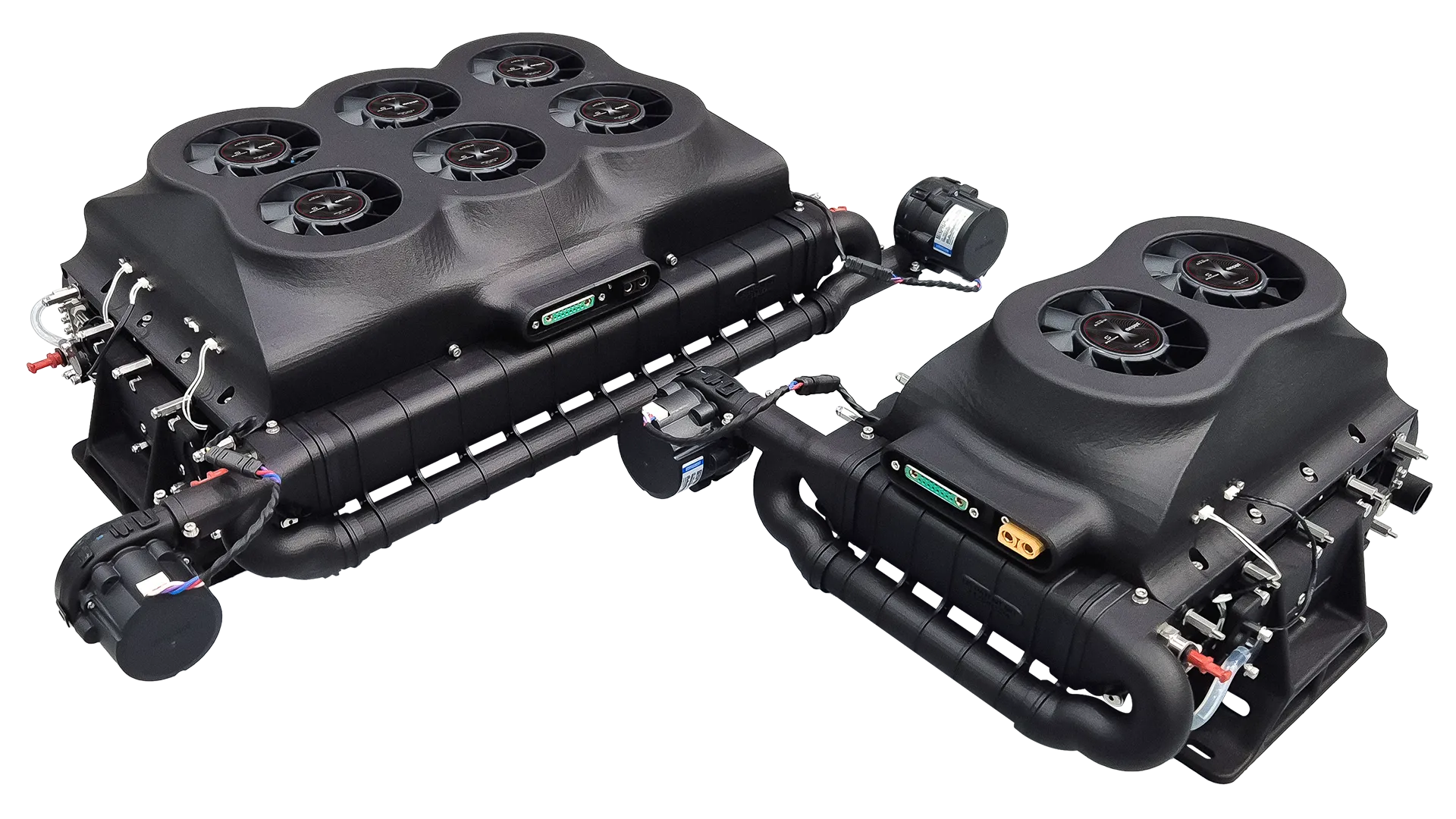
The Protium series has a modular design. A cell can be combined with additional units as needed. This means that increased performance or range are no problem. (Photo | Spectronik)
The control unit distributes the cooling capacity specifically to several fans. This means that no single fan has to run continuously at maximum power. This protects the components, increases service life and saves energy. An additional advantage: Thanks to their DC motors, the fans operate particularly efficiently in the partial load range.
In addition to the right temperatures, oxygen supply is crucial. This is ensured by one or two RVE 45 radial fans from ebm-papst. They literally allow the fuel cell to “breathe” by supplying fresh air from outside and dynamically adjusting the air flow according to power requirements. This ensures that the cell always has enough oxygen for the reaction to produce sufficient energy, even during peak performance periods.
More power? More cells!
Spectronik fuel cells are compact, powerful and efficient. But what if the power of one cell is not enough to drive the entire vehicle? Spectronik has also thought of this scenario and designed its Protium series to be modular. This means that a cell not only works on its own, but can also be combined with other units as needed. More power or range are therefore no problem. Cooling and oxygen supply are part of the modular concept and are permanently integrated into each unit.
Spectronik is thus initiating a revolution in fuel cells. Mobile applications are gaining endurance—without heavy or complex battery systems. Drones can fly entire missions with ease instead of just short rounds. Household robots can work all day without having to be constantly recharged. And golf carts remain in continuous use instead of spending hours plugged into the power outlet. Where conventional batteries fail, hydrogen provides more power and range—efficiently, compactly and flexibly scalable.
Leave a comment