
Listening to music on the go or streaming TV shows from the couch, quickly ordering a new pair of pants, chatting with a friend overseas — the digital world makes it all possible. And it all seems to happen invisibly and immaterially. However, nothing could be further from the truth: Every piece of information relies on tangible infrastructure, traveling as data packets made of electrons and photons through fiber-optic cables from A to B. The backbone of our digital lives consists of densely packed undersea cables stretching for millions of kilometers, as well as countless receiving and relay stations on land. If something goes wrong there, it leads to delays, data loss, or — in the worst case — a network outage.
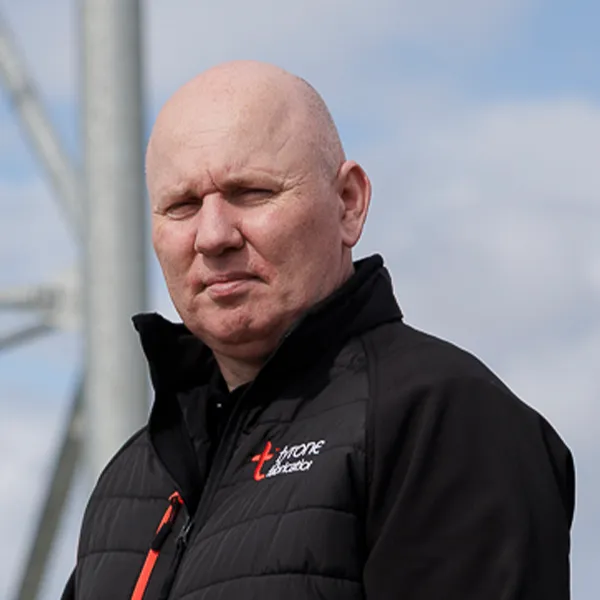
Our customers are already building capacity for the next 10 to 15 years — which means we’re installing more and more high-performance racks in small buildings.
Andre Hudson, Design Manager Tyrone Fabrication
Where the Internet has an address
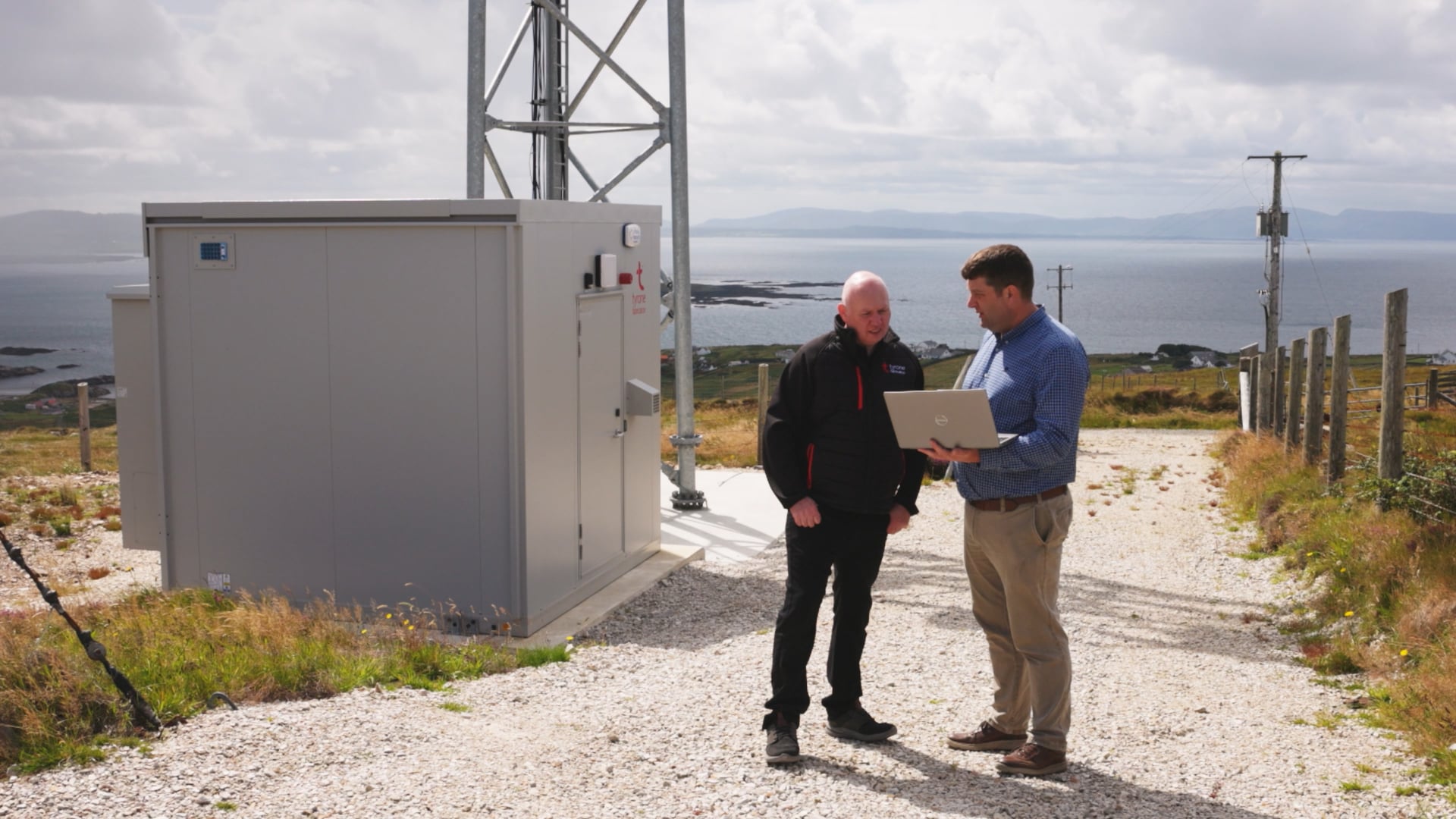
Andre Hudson, Design Manager at Tyrone Fabrication, knows this because it’s his job to make sure an outage never happens. Companies that lay fiber-optic and telecommunications networks across the EU commission Tyrone Fabrication to build the associated critical infrastructure. Most of the time, these are very unassuming, container-like buildings. They house and protect the sensitive technology that enables our daily use of the Internet. Take, for example, cable landing stations — the true hubs of the internet: This is where the optical signals from a submarine cable are transferred to the terrestrial network. Or inline amplifiers, which boost the signal approximately every 70 kilometers along fiber optic routes. Or small fiber exchange cabins, like the one on the beautiful Irish island of Arranmore. The small cabin, which measures just a few square meters, houses complex technology that bundles fiber-optic cables, transmits data traffic and monitors it — generating a lot of heat in the process.
Good Reception
Andre Hudson of Tyrone Fabrication and Ray O’Connor of Akrivis on the Irish island of Arranmore. The small gray container is a fiber-optic station: Andre Hudson built it, and Ray O’Connor keeps it cool.

Amplified Fiber-Optic Signals
Tyrone builds facilities across Europe for critical infrastructure, such as cable landing stations and in-line amplifiers. These amplify fiber-optic signals over long distances.
“Heat is the biggest enemy of reliable network operation,” says Andre Hudson as he stands next to the little cabin on Arranmore with the wind whipping around his ears. “No matter what kind of critical infrastructure we’re talking about.” That’s why Ray O’Connor, Commercial Director at Akrivis, is also on site. The climate control specialist supplies modular cooling solutions for the stations that Tyrone is building. Hudson and O’Connor have been working together for many years; their companies have been partners for more than two decades. In the beginning, Akrivis just supplied Tyrone with individual fans for smaller projects; today, they offer a broad portfolio for data center-related applications. And they rely entirely on fans from ebm-papst.
The heat load is the deciding factor
When Tyrone plans a new project, designing the cooling system is one of the first steps. The basis for this is the building’s location and the number of servers installed inside. For a typical inline amplifier, this usually amounts to around 24 19-inch racks. “The customer tells us how much heat each rack generates during operation. That can range from two to three kilowatts, or even more with higher rack density,” explains Hudson. This determines the estimated heat load, the placement of the equipment — for monitoring, control, and power supply — and the cooling requirements. Akrivis’s typical solution for an inline amplifier consists of so-called dual cooling units, which Tyrone installs on the exterior of the building. “Dual” means that the units use ambient air for cooling in free cooling mode and only activate a separate refrigeration circuit when outdoor temperatures are high.

High performance, low carbon:
ebm-papst reimagines data center cooling. Our efficient cooling solutions combine energy efficiency with high power density.
Using ambient air for cooling
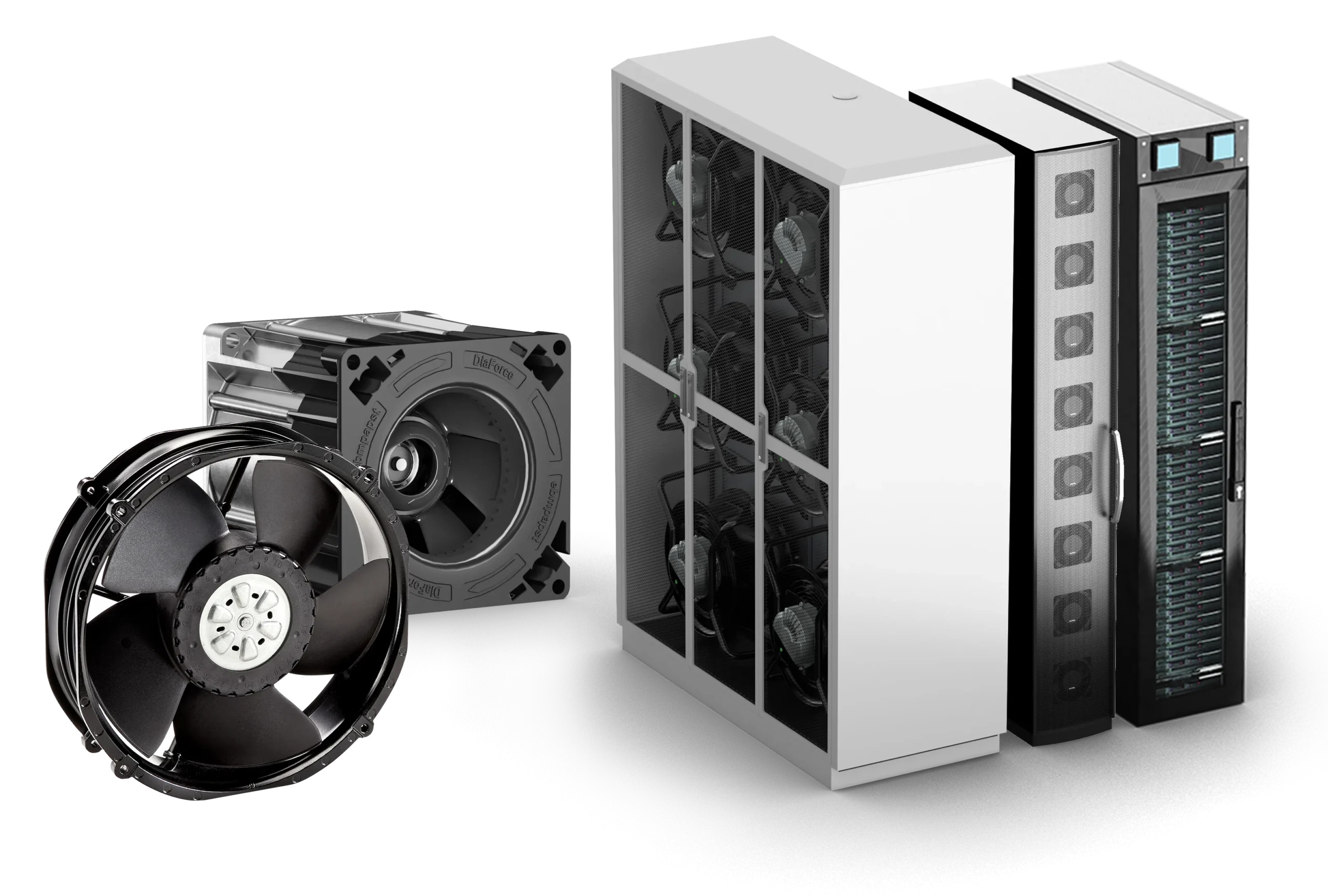
To achieve this interplay, Akrivis installs between three and six ebm-papst fans — specifically AxiEco and RadiCal — depending on the model. In free cooling mode, one centrifugal fan acts as a fresh air fan. It draws in cool, ambient air from the outside and exhausts warm air to the outside through AxiEco. RadiCal is intelligently controlled based on the current IT load and ambient temperature, reaching an airflow of up to 3,500 cubic meters per hour.
That's how Dual Cooling Units work
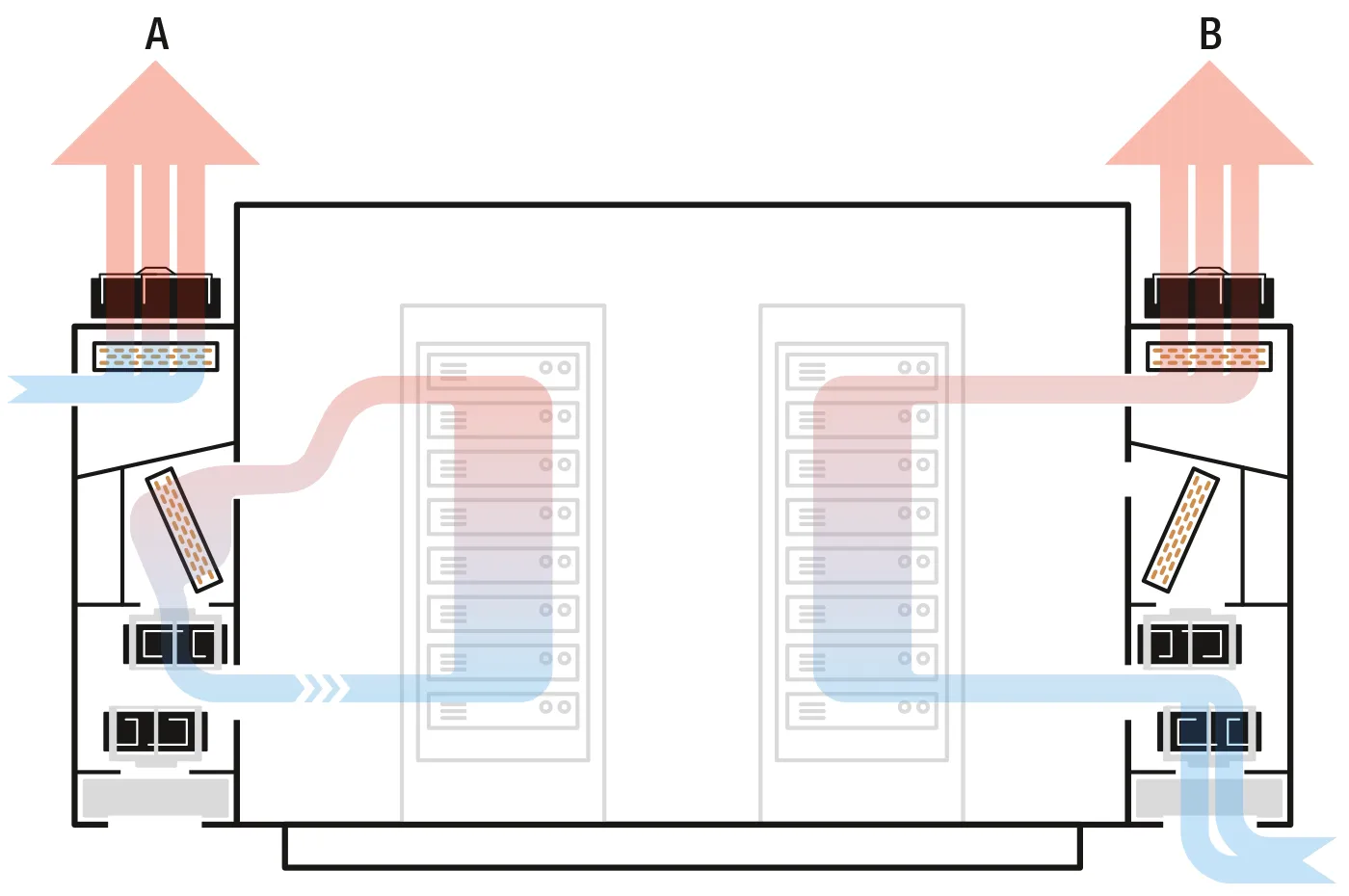
The dual cooling units are mounted on the exterior of the buildings. They combine free cooling—that is, cooling using ambient air (A)—with mechanical DX cooling (B). In tis way, Akrivis and Tyrone ensure reliable grid operation. (Image | Gernot Walter)
If the ambient temperature exceeds the setpoint, the control system deactivates free cooling mode and switches on mechanical DX cooling. In this mode, another RadiCal handles air circulation through the refrigeration circuit. AxiEco acts as a condenser fan, dissipating the heat to the outside and reaching an airflow of up to 6,000 cubic meters per hour. For the refrigeration circuit, Akrivis uses a variable-speed compressor, which ensures precise temperature control.
“Servers today have much higher temperature setpoints than in the past. At the same time, thanks to the variable speed of the fans, we achieve exactly the right temperature using less energy,” explains Ray O’Connor. “Even in hot regions like southern France, depending on setpoint, we meet in excess of 90 percent of the cooling demand using only ambient air.” This drastically reduces the energy consumption and CO₂ emissions of critical infrastructure. According to Akrivis, this enables customers to achieve a power usage effectiveness (PUE) as low as 1.04. This means that for every unit of electricity consumed by IT systems such as servers, the infrastructure requires only an additional four percent for cooling.

Made in Ireland
Akrivis designs and manufactures its various cooling solutions in Portlaoise, Ireland. The company takes pride in its local and European value creation.

Dual Cooling
Akrivis' Dual Cooling Units combine ambient air cooling with mechanical DX cooling. They use RadiCal and AxiEco fans for this purpose.
Long-Standing Partnership
From the very beginning, Akrivis has relied on fans from ebm-papst—selecting specific models in various sizes depending on the cooling solution. After all, the efficiency of the cooling solutions is a key selling point for customers.
Security is the be-all and end-all
Regardless of the building’s size, Tyrone always designs cooling systems with N+1 redundancy — that is, one unit on standby in case one fails. The fans themselves are classified as environmental class H₂, which means they can withstand direct contact with water over the long term without any risk of corrosion. Both of these factors are important to customers for safety reasons. Network builders also prioritize noise protection. Especially for buildings located near cities, they conduct measurements before commissioning, explains Andre Hudson: “With Akrivis’s cooling solution, we’re on the safe side. The fans are extremely quiet even at high speeds.”

We meet in excess of 90 percent of the cooling demand using only ambient air.
Ray O’Connor, Commercial Director Akrivis
Akrivis’s modular, plug-and-play units make Hudson’s job easier. But there are also projects that unfold quite differently. This year, a customer commissioned Tyrone to build a cable landing station, but since the customer already had a building near the sea, Tyrone was tasked with building inside it — a building within a building. “Space is becoming scarce in some areas, and our customer wanted to use the existing space. However, the question now was: How do we cool with outside air when there isn’t any?” The simplest solution would have been to use units with a refrigeration cycle. But for efficiency reasons, the customer wanted a solution with free cooling.
Andre turned to Akrivis to work out how this could be done. The engineers modified a classic CRAC unit so that it could deliver the required performance using fresh air supplied through air ducts. To ensure safety, they also developed an emergency cooling mode: In the event of a three-phase power failure, the fans are powered by batteries, ensuring there still is cooling available. Andre Hudson was satisfied: “It’s precisely in projects like this that we see how well our collaboration works as long-standing partners. We rely on Akrivis’s expertise and know-how.”

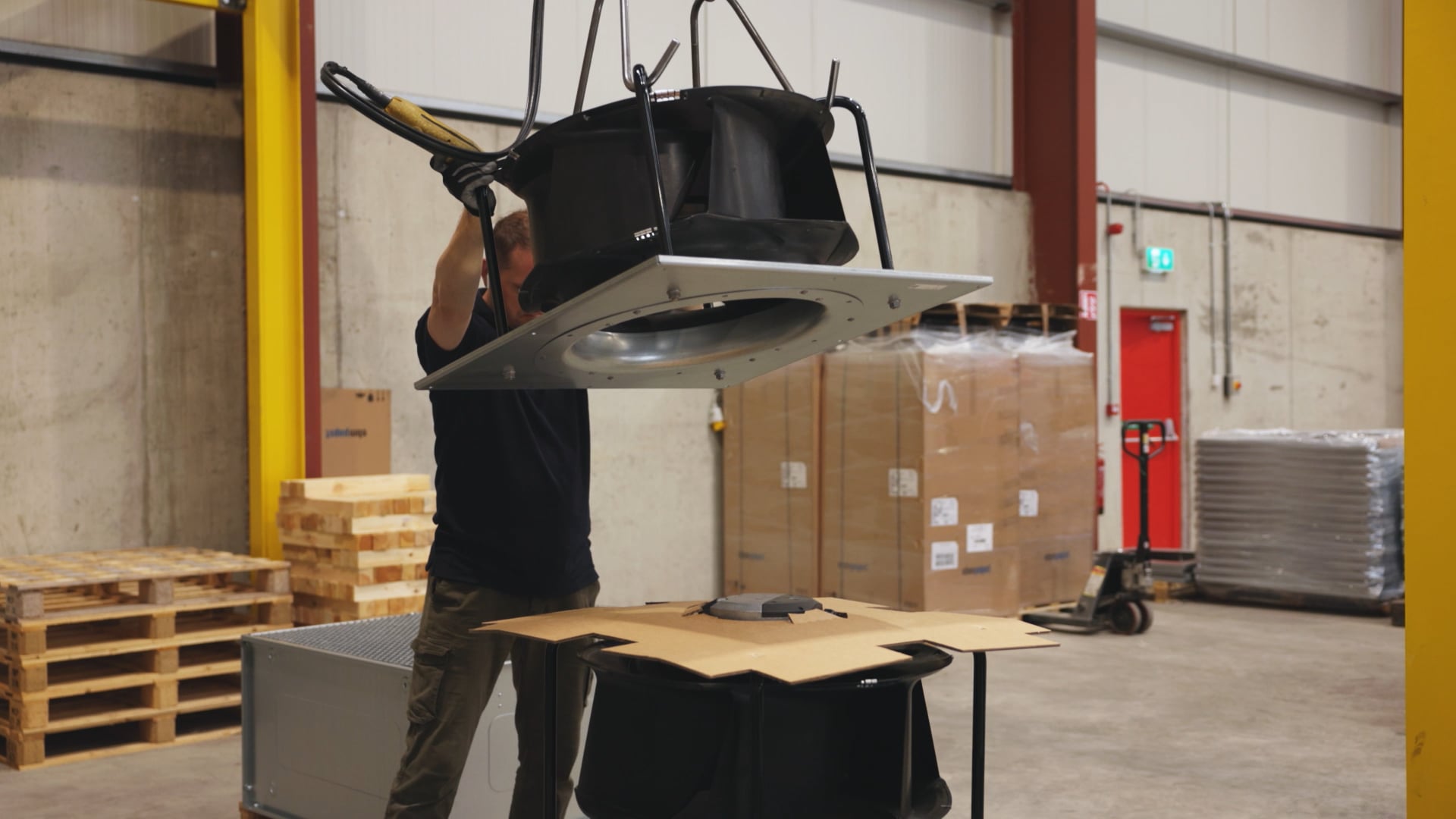
Efficient Even at High Power Output
An employee installs and wires the fans. The combination of RadiCal and AxiEco ensures maximum efficiency in the Dual Cooling Unit. According to Akrivis, this enables customers to achieve a Power Usage Effectiveness (PUE) of just 1.04.
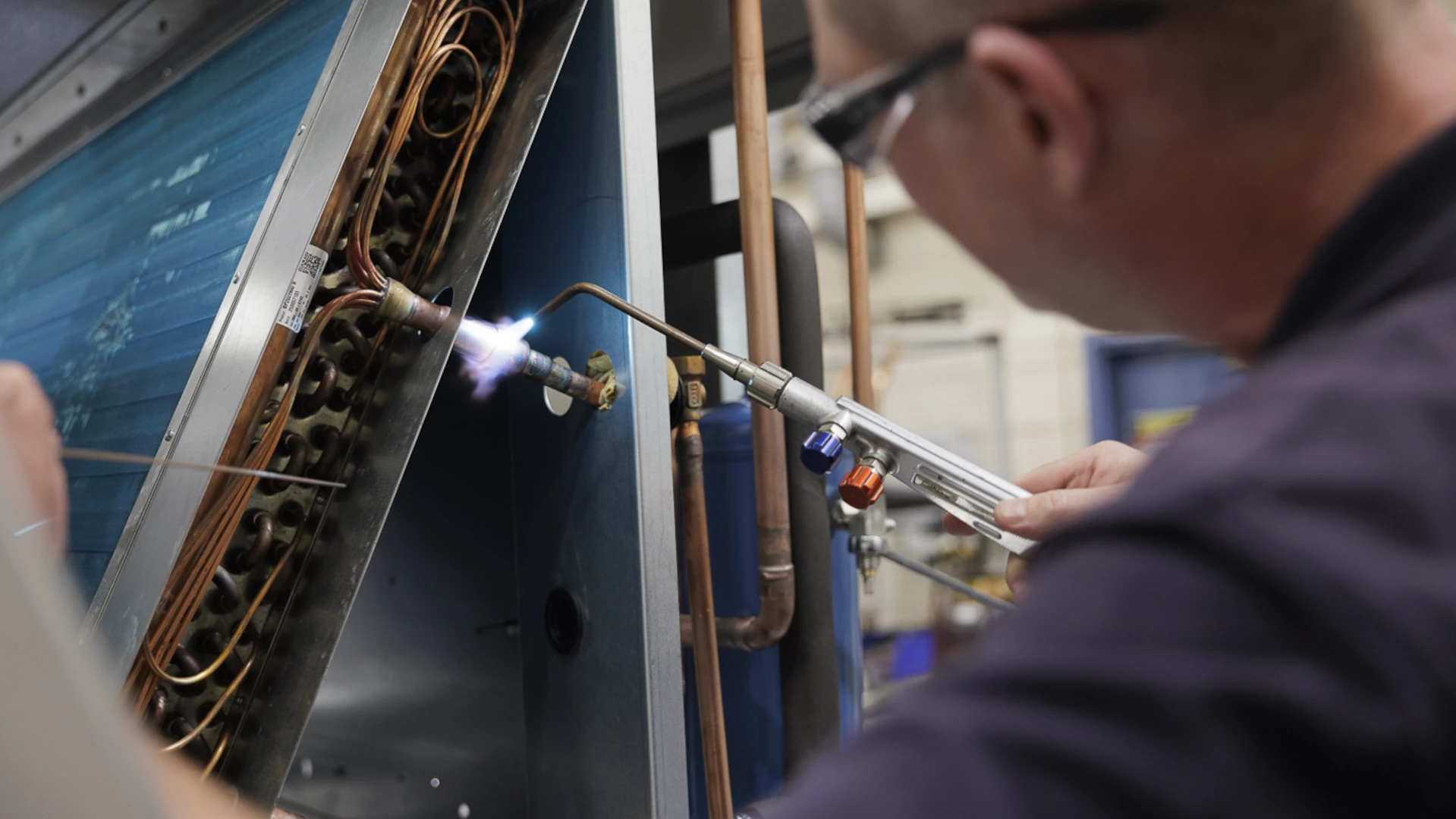
Mechanical DX Cooling
An employee is welding the heat exchanger. In DX mode, the RadiCal directs air through the refrigeration circuit. A variable-speed compressor ensures precise temperature control.
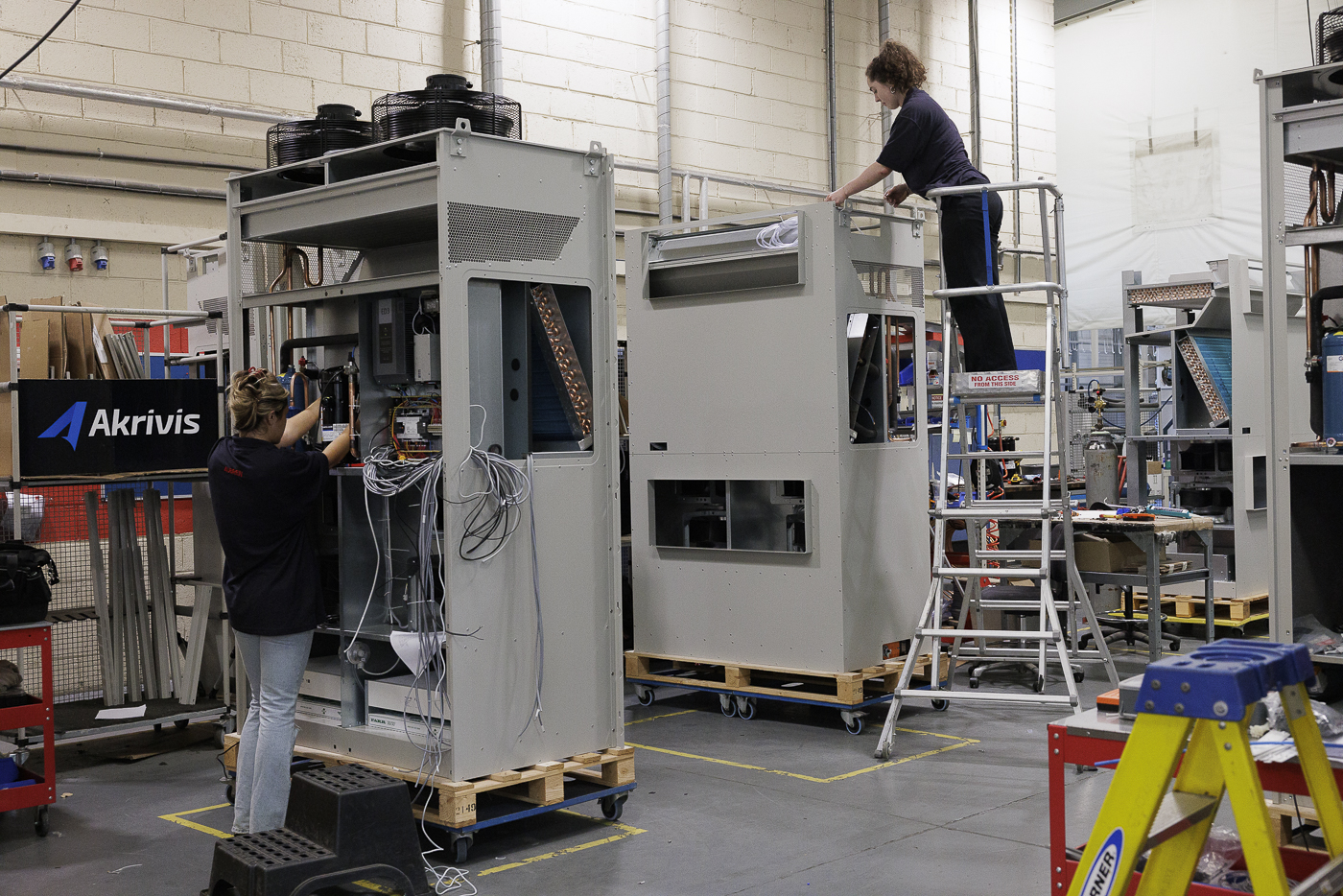
Focus on Safety
The fans are rated H2 for environmental protection and remain quiet even at high power. The latter is important to customers who are building structures near urban areas.
Is AI changing everything?
Both expertise and know-how are becoming increasingly important skills because thanks to AI, everything is getting more intense and demanding. Data volumes are growing, and major cloud providers — so-called hyperscalers — are pushing for more robust infrastructure. Andre Hudson is already noticing this: “Our customers are having a hard time finding affordable land. That’s why they’re already building capacity for the next 10 to 15 years — which means we’re installing more and more high-performance racks in small buildings.” Ray O’Connor adds: “Today, we can cool up to 12 kilowatts of heat output per rack with air. This increased heat load is relevant both for hyperscalers and other AI-ready infrastructure — and they are already talking about 100 kilowatts and higher. These figures are changing the nature of our work and the cooling technology required. Cooling solutions are becoming even more important for guaranteeing constant availability — from email to chatbots and streaming services.”
On Arranmore, there’s little sign of this yet. A small, unassuming building on the edge of the coast quietly and reliably goes about its business. Out here, the cool breeze blows on its own.
Leave a comment