
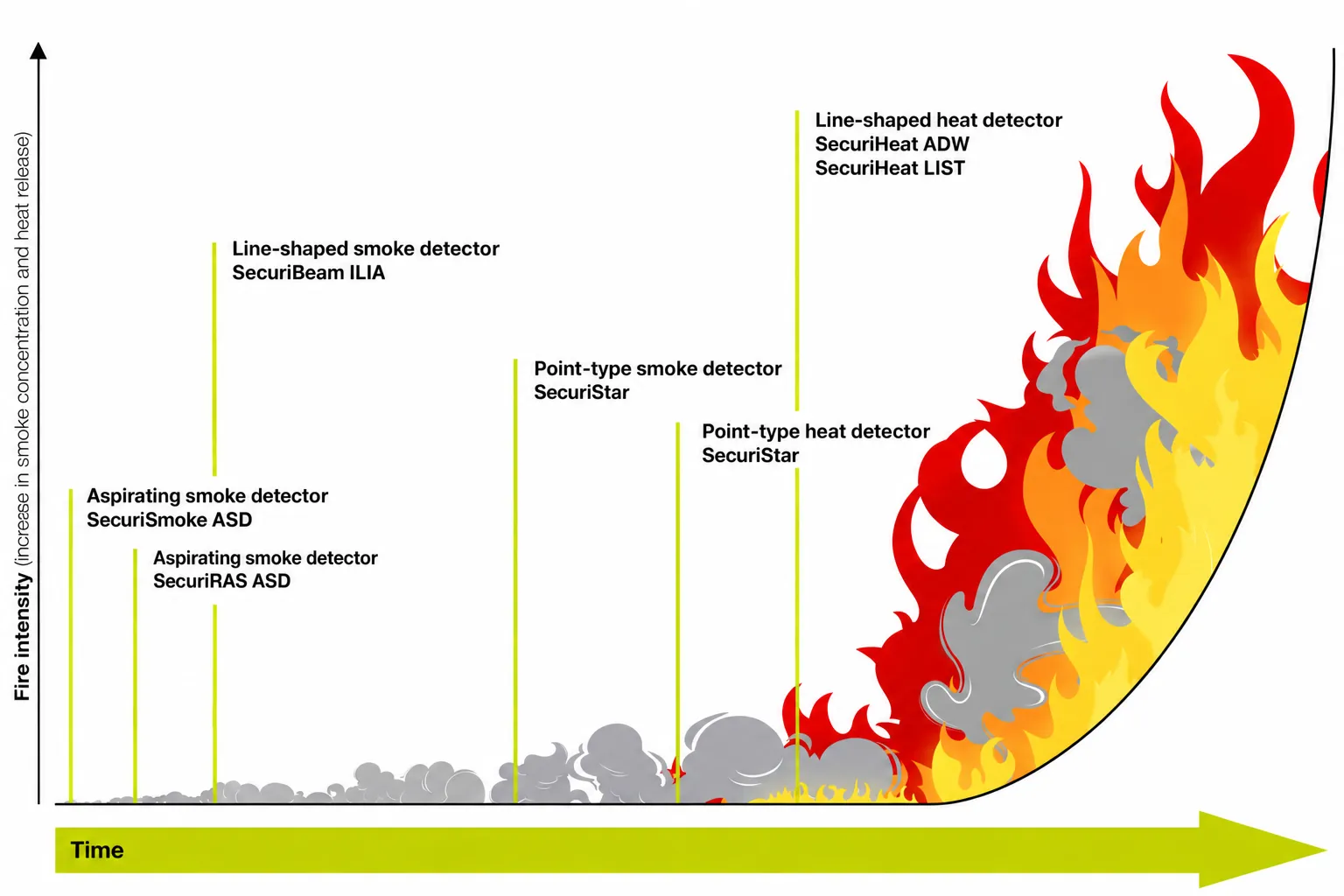
Every second counts in early fire detection – whether in data centers, museums, or logistics warehouses. If a fire breaks out in these settings, the stakes are high. Flames, soot, and fire suppressants can destroy critical data, works of art, and goods – and in the worst-case scenario, risk human lives. The aspirating smoke detectors in Securiton’s SecuriSmoke ASD 2000 product family help prevent this: They detect the start of a fire immediately, based on the very first smoke particles. “To do this, our aspirating smoke detectors continuously draw in air through a network of pipes up to 700 meters long,” explains Hakan Sahin, hardware development engineer and system architect at Securiton. The Switzerland-based company develops comprehensive and integrated security solutions. Active early fire detection is one of its core business areas. “Unlike passive smoke detectors, aspirating smoke detectors don’t just detect smoke once it has risen to the ceiling. They actively draw air from the surrounding area, enabling them to detect fires early and across large areas.”
Light makes smoke visible
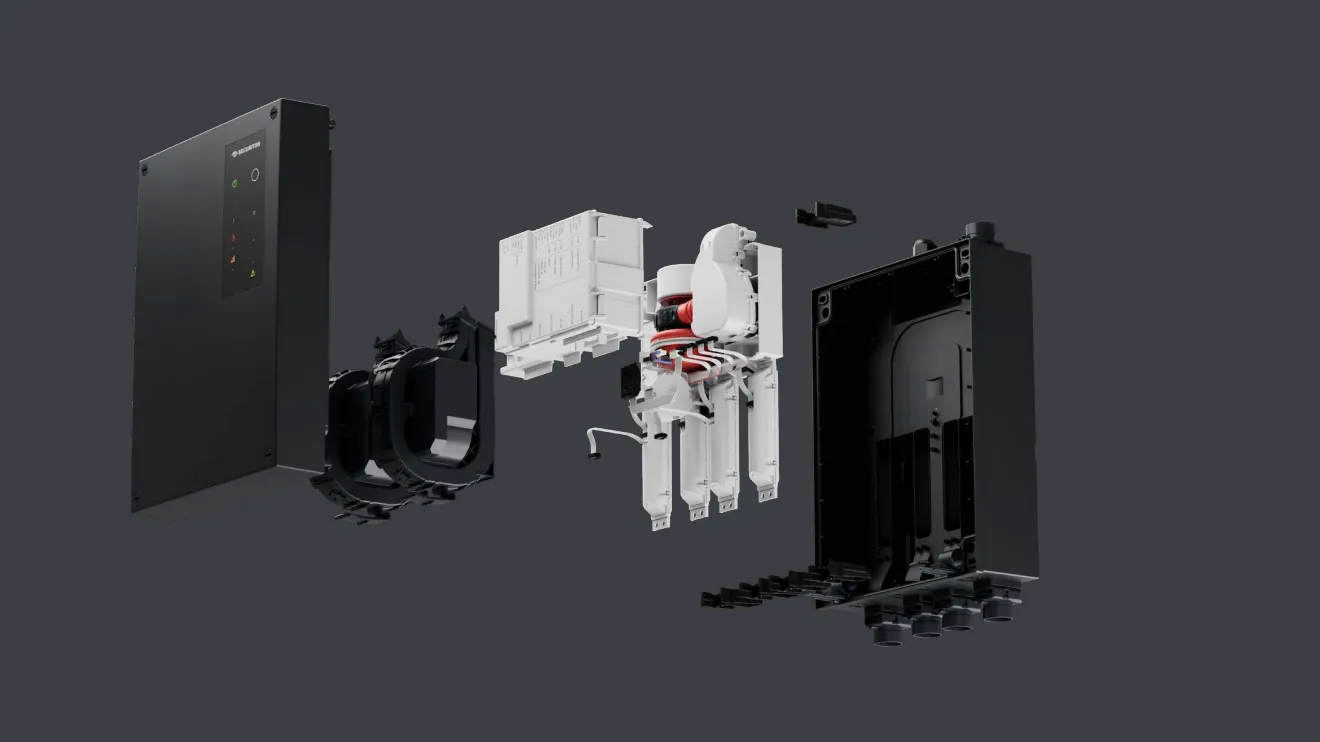
But how does an aspirating smoke detector reliably detect whether there is smoke in the air? To do this, every aspirating smoke detector contains a sensor that operates on the principle of scattered light: The aspirated air flows through a measurement chamber where light strikes the particles it contains. Smoke particles alter the light scattering in a specific way, and the sensor detects this. The upstream internal centrifugal separator filter (CS filter) separates larger dust particles from smaller smoke particles, ensuring that only the smaller particles enter the measuring chamber. “This is how our aspirating smoke detectors reliably detect smoke and prevent unwanted false alarms,” adds Hakan Sahin.
0 square meters
monitor large areas
The right device for every space
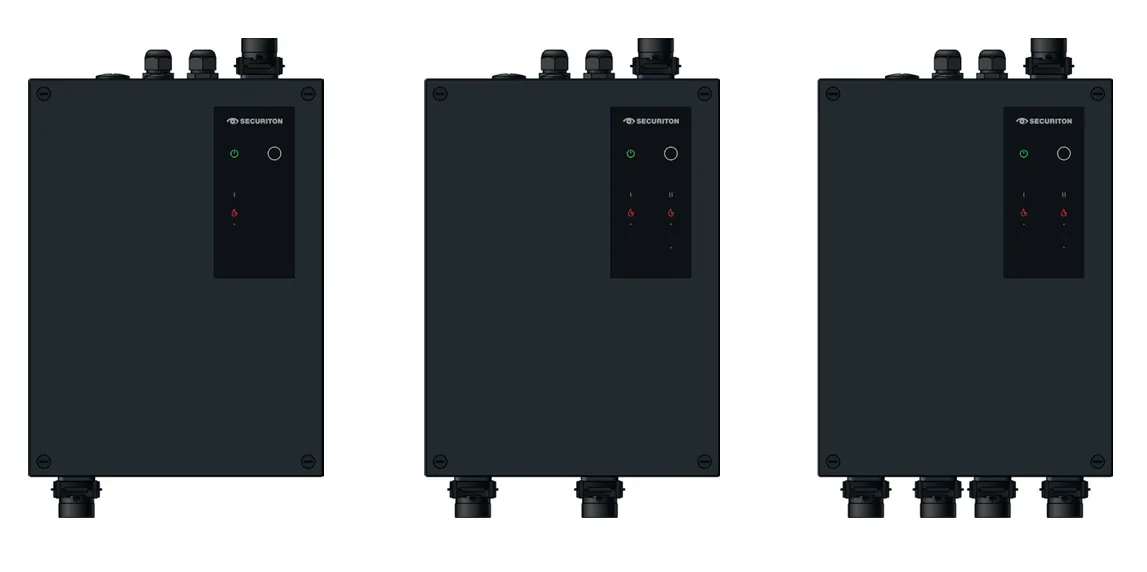
Securiton’s aspirating smoke detectors monitor the air in a wide variety of applications, from server rooms to large warehouses. That’s why the SecuriSmoke ASD 2000 product family consists of three models. “Our ASD 2001 is designed for smaller areas up to 3,000 square meters and operates with one duct connection and one smoke sensor. The ASD 2002 uses two duct connections and two independent smoke sensors. And the ASD 2004 features four duct connections, with two of them leading to each of the two smoke sensors. This allows for the monitoring of significantly larger or partitioned areas of up to 5,760 square meters,” says Hakan Sahin.
In addition, the aspirating smoke detector continuously monitors the airflow in the duct network. Securiton uses ultrasonic sensors for this purpose. A change in airflow may indicate a malfunction in the duct system, such as a duct rupture or a clogged intake opening. As a result, the system not only detects smoke particles but also monitors the condition of the duct network.
Nothing works without a fan
For the aspirating smoke detector to work, it needs one more key component. Hakan Sahin explains: “The heart of the system is the fan. It draws in air and channels it through the ductwork to the smoke sensor. This is what makes the principle of active early fire detection possible in the first place.” The demands placed on the fan are correspondingly high: “Above all, the fan must be very powerful to transport the smoke particles to the smoke sensors quickly enough. In addition, high efficiency and a compact design were important to us during development so that the fan would fit into the limited installation space of the aspirating smoke detector.”
“We designed the fan for the speed range relevant to us – 7,000 to 20,000 rpm.”
Hakan Sahin, hardware development engineer and system architect at Securiton
The RVE45 from ebm-papst provided the optimal foundation to address these demands. With a faceplate measuring approximately 65 by 65 millimeters, the centrifugal fan delivers substantial performance in a small space. Its dynamic EC internal rotor motor achieves high speeds and responds quickly to changing pressure conditions. For use in the SecuriSmoke ASD 2000 product family, however, the standard production model was not sufficient. Securiton and ebm-papst jointly tailored the RVE45 to the application. “We designed the fan for the speed range relevant to us – 7,000 to 20,000 rpm – and optimized the bearing technology and the electrical interface for our application,” explains Hakan Sahin. To this end, both companies also conducted extensive testing to implement the individual requirements step by step. The temperature range proved particularly challenging. The RVE45 is designed to operate just as reliably at -30 degrees Celsius as it does at +60 degrees Celsius – and to do so over a long service life. The solution: a special low-temperature bearing grease.
Fire protection at minimal volume
In addition to suction power, energy efficiency, and a compact design, noise levels also play a role – especially in spaces where people spend a lot of time. “Museums are a good example. Here, visitors want to experience art and culture – not hear the fire alarm system,” says Hakan Sahin. That’s why Securiton and ebm-papst not only chose a particularly quiet fan but also designed its installation to minimize noise and vibration. The result: At the lowest speed, the aspirating smoke detectors reach a sound pressure level of around 21 decibels. That’s even quieter than a whisper. As a result, the aspirating smoke detectors in the SecuriSmoke ASD 2000 product family remain acoustically in the background and only sound the alarm when it really matters. For data centers, museums, or logistics warehouses, this means first and foremost that people are notified early on when smoke develops, providing valuable time for alerting others and evacuating.
Leave a comment