
The requirements for modern refrigeration and ventilation systems have changed significantly in recent years. In addition to traditional parameters such as airflow and pressure, the focus today is increasingly on energy efficiency, controllability, noise performance, and system integration. At the same time, regulatory requirements are increasingly shifting the evaluation of fans to the system level.
Against this backdrop, EC technology has established itself as the standard for fan drives. Its advantage stems not from a single characteristic, but from the interplay of efficiency, intelligent control, and system integration.
Operating Principle and Technical Fundamentals of EC Technology
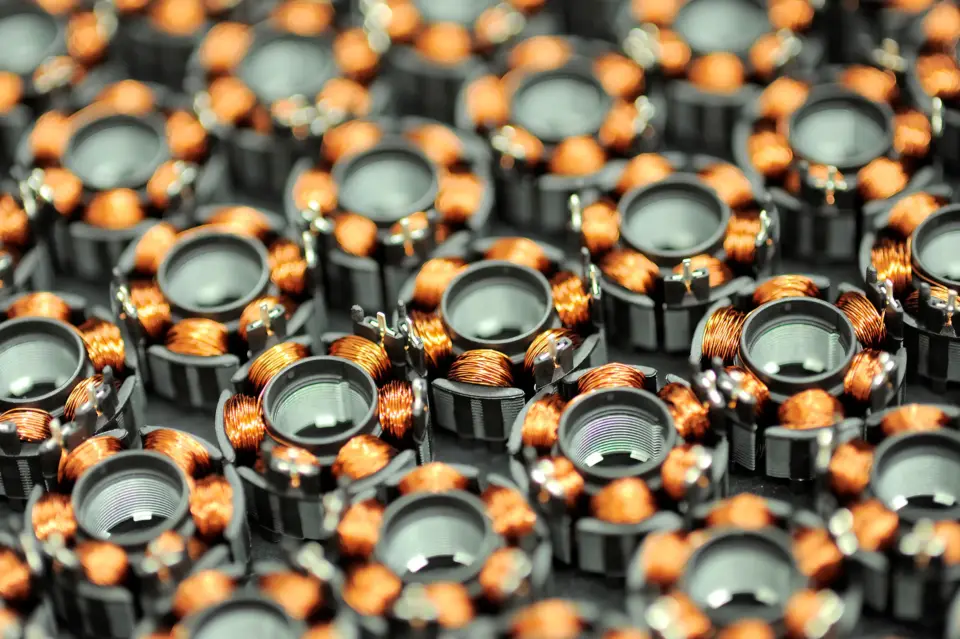
EC motors are permanent magnet-excited synchronous machines with integrated power electronics. Commutation is performed electronically, eliminating mechanical wear parts and enabling precise control of the current flow.
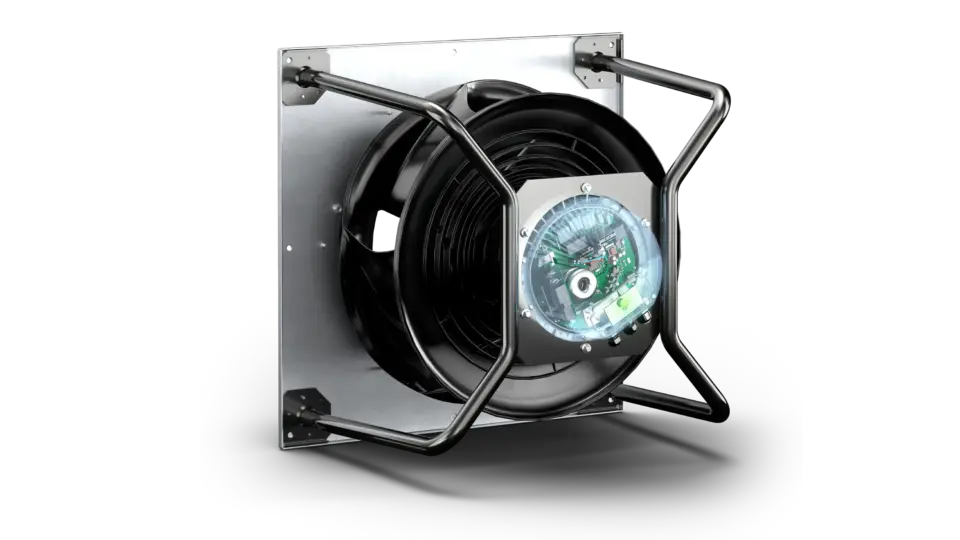
The electronics perform several functions simultaneously: they convert alternating current to direct current, generate a variable rotating field, and synchronize it with the rotor position. This results in operation with minimized losses with uniform torque. Unlike AC systems, the control is directly integrated. The fan is thus designed as a complete mechatronic system in which the motor, electronics, and control are optimally integrated.
This integration enables:
- stepless speed control
- stable operation
- integration into higher-level systems
AC vs. EC Technology: Technical Comparison
| Criterion | AC technology | EC technology |
| Motor principle | Asynchronous with slip | Synchronous with permanent magnet |
| Control | external control required | Integrated |
| Speed response | limited variability | continuously variable |
| Efficiency | load-dependent | High across the entire range |
| System integration | Low | high |
The key difference lies in slip: In AC motors, system-related losses arise from the difference between the rotating field and the rotor. EC motors avoid these losses through synchronous operation.
Why EC Technology Is More Efficient
The higher efficiency results from several factors: In an AC motor, torque is generated via induced rotor currents—a loss mechanism inherent to the design. EC motors, on the other hand, use permanent magnets and generate torque directly. This completely eliminates rotor losses. At the same time, electronic commutation ensures precise current control and minimizes reactive power. Additionally, EC fans are designed as direct-drive systems, thereby avoiding further losses caused by external components. The key point: Efficiency is achieved at the system level, not just within the motor.
Demand-Driven Operation as a Key Efficiency Lever
In real-world applications, air demand rarely remains constant. In office buildings, for example, the required fresh-air flow decreases when rooms are unoccupied because less moisture, CO₂, and heat need to be removed. In data centers and industrial processes, thermal loads also vary with current utilization, which continuously shifts the required airflow and the fan operating point.
For such variable operating conditions, speed control is generally the technically preferable method of adapting fan performance to actual demand. By contrast, throttling changes the operating point, but usually does not reduce energy consumption proportionally.
The fan laws describe the aerodynamic scaling behavior of the fan and are useful for illustrating trends. As a first approximation, the air-side power requirement of the impeller changes with the cube of speed (P ~ n³). However, the measured efficiency and electrical input power of the complete fan system must always be evaluated at the actual operating point.
A simplified example illustrates the trend: if fan speed is reduced from 100% to 80%, the theoretical impeller power requirement falls to about 51% of the reference value. At 50% speed, it falls to about 12.5%. In practice, the actual electrical power demand and the achievable savings depend on the complete fan system, including the motor, control electronics, fan design, installation conditions, and air density.
The essential point remains the same: in applications with variable load profiles, substantial savings potential is typically achieved by operating the fan efficiently at partial load rather than by running continuously at full speed.
Grid Behavior and Electromagnetic Compatibility (EMC) in EC Fans
The use of power electronics is a key prerequisite for the high efficiency and controllability of EC fans. At the same time, it entails specific requirements regarding electrical grid behavior. Since EC drives operate internally with a rectifier, DC link, and inverter, they are nonlinear loads. The current drawn therefore deviates from the ideal sinusoidal waveform and contains harmonics. These distortions can be described as Total Harmonic Distortion (THD) and can affect both power quality and the behavior of other connected loads.
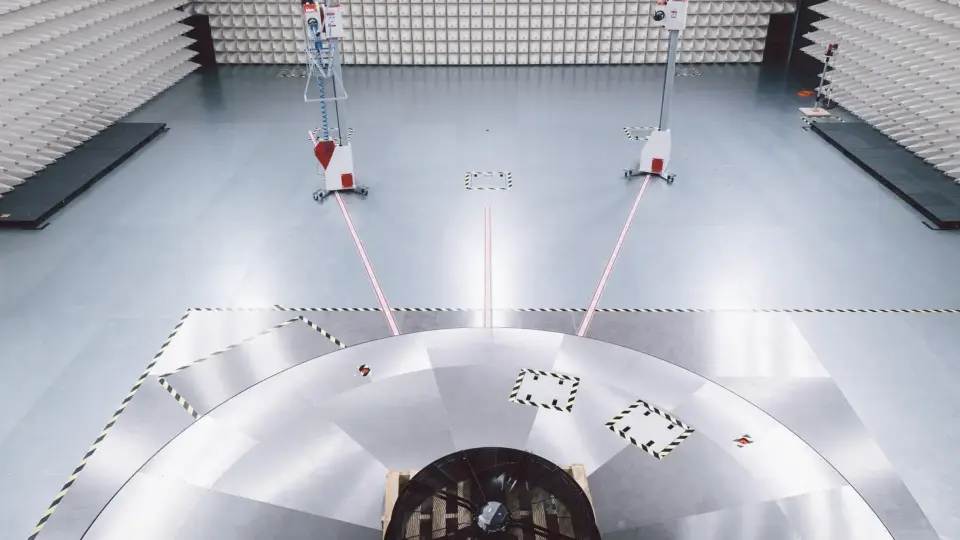
For integration into industrial and HVAC systems, a dedicated EMC design approach is therefore required. Modern EC fans already take these aspects into account during development: Through coordinated filter concepts, optimized switching strategies, and careful design of the power electronics, both conducted and radiated interference emissions are minimized. In addition, immunity to external influences is tested to ensure stable operation even in complex systems. To this end, ebm-papst utilizes extensive EMC laboratory infrastructure with various measurement environments and testing capabilities for a wide range of applications. This allows both emissions and immunity to be systematically validated and optimized. The central challenge here is: How can the fan be made as grid-friendly as possible despite its power electronic connection?
Active PFC: Power Factor Correction to Reduce Grid Interference

Power quality under control – no extra effort required!
Discover in the white paper how integrated active rectification makes EC fans ready for the toughest requirements.
A key technological solution to this challenge is Active Power Factor Correction (Active PFC). Without appropriate measures, the nonlinear current consumption of EC drives leads to an poor power factor: current and voltage are out of phase, and the current waveform contains additional harmonics. This reduces the usable active power while simultaneously increasing the load on the power grid. Active PFC circuits specifically address this behavior. They actively shape the drawn current so that it is as sinusoidal as possible and in phase with the mains voltage. This significantly improves the power factor and reduces the impact on the electrical grid.
In practice, this results in several key advantages: harmonic distortion is reduced, energy is transmitted more efficiently, and grid stability increases—especially in systems with many fans operating in parallel, such as in data centers or large ventilation systems. Thus, Active PFC does not function in isolation as a feature of power electronics, but rather as an integral part of a comprehensively optimized overall system that operates both efficiently and in a grid-friendly manner.
Technology Leadership and Experience
EC technology was first used by ebm-papst in fans over 50 years ago and has been continuously refined.
This experience is particularly evident in:
- robust system solutions
- high reliability
- optimized system integration
The combination of experience and innovation forms the foundation for today’s state-of-the-art technology.
FAQ – Frequently Asked Questions About EC Technology
EC motors operate synchronously with integrated electronics, while AC motors require external control.
Due to the elimination of slip losses and optimal controllability.
This is where the greatest energy savings are achieved through speed control.
EC enables demand-based operation and system integration and is therefore almost always the technically superior choice in practice.
They ensure grid quality and stable system operation.
Conclusion on EC Technology in Ventilation Technology
EC technology represents the state of the art in fan technology today. Its strength lies particularly in the combination of high energy efficiency, precise controllability, and integrated system functionality. Unlike traditional drive concepts, the fan is no longer viewed in isolation but as part of a networked system whose operating point can be continuously adjusted to real-world requirements. This helps prevent energy losses while simultaneously optimizing stability, noise performance, and service life.
EC technology shows its full potential particularly with variable load profiles: The combination of variable-speed operation, integrated electronics, and systemic optimization leads to significant efficiency gains in real-world plant operation. With increasing digitalization—such as through networked solutions and data-driven analysis—the fan is also evolving into an intelligent system component that actively contributes to increased efficiency and operational reliability. With NEXAIRA, ebm-papst has introduced the first digital ecosystem for intelligent ventilation applications. As a result, EC technology is no longer just an option, but the preferred solution in most applications.
Leave a comment