Modern sheetfed offset presses are extremely sensitive to temperature fluctuations and humidity. Even slight deviations can change the behavior of the paper—it expands, curls or absorbs ink unevenly. “If the temperature or humidity is not right, the quality suffers immediately,” explains Christoph Herzog, Managing Director of the Mayr Miesbach printing company. “We have to work precisely—and that includes equally precise ventilation.”
The latest technology
The new Rapida 106 sheetfed offset press lives up to its name. At the state-of-the-art Mayr printing plant in Miesbach, Bavaria, the press produces up to 18,000 sheets per hour.
Precise climate, precise printing
However, in order to print on a wide variety of paper types with brilliant colors and in the highest quality, a stable room climate is required.
Strong partners from concept to implementation
When Peter Berberski, sales engineer at building automation specialist Kieback&Peter, called on the print shop because of a faulty control cabinet, he also noticed the outdated ventilation system. He contacted retrofit expert Dieter Hildebrandt from Breuell & Hilgenfeldt, the ebm-papst service center. The two have known each other for years through the annual Energy Forum in Rosenheim and have learned that their skills complement each other perfectly.
“As with the Mayr printing company, we work directly with many customers on their systems and recognize where modernization is sensible and necessary,” says Berberski. “Together with Breuell & Hilgenfeldt, we can implement such projects holistically—from high-efficiency control to energy-efficient fans.” It is often possible to obtain subsidies for modernization. This was also the case at the Mayr printing company, as all the requirements were met, including an energy-efficient conversion of the ventilation system and the modernization of the control technology. Kieback&Peter applied for the subsidy and successfully implemented it as part of a subsidy partnership for the entire project.
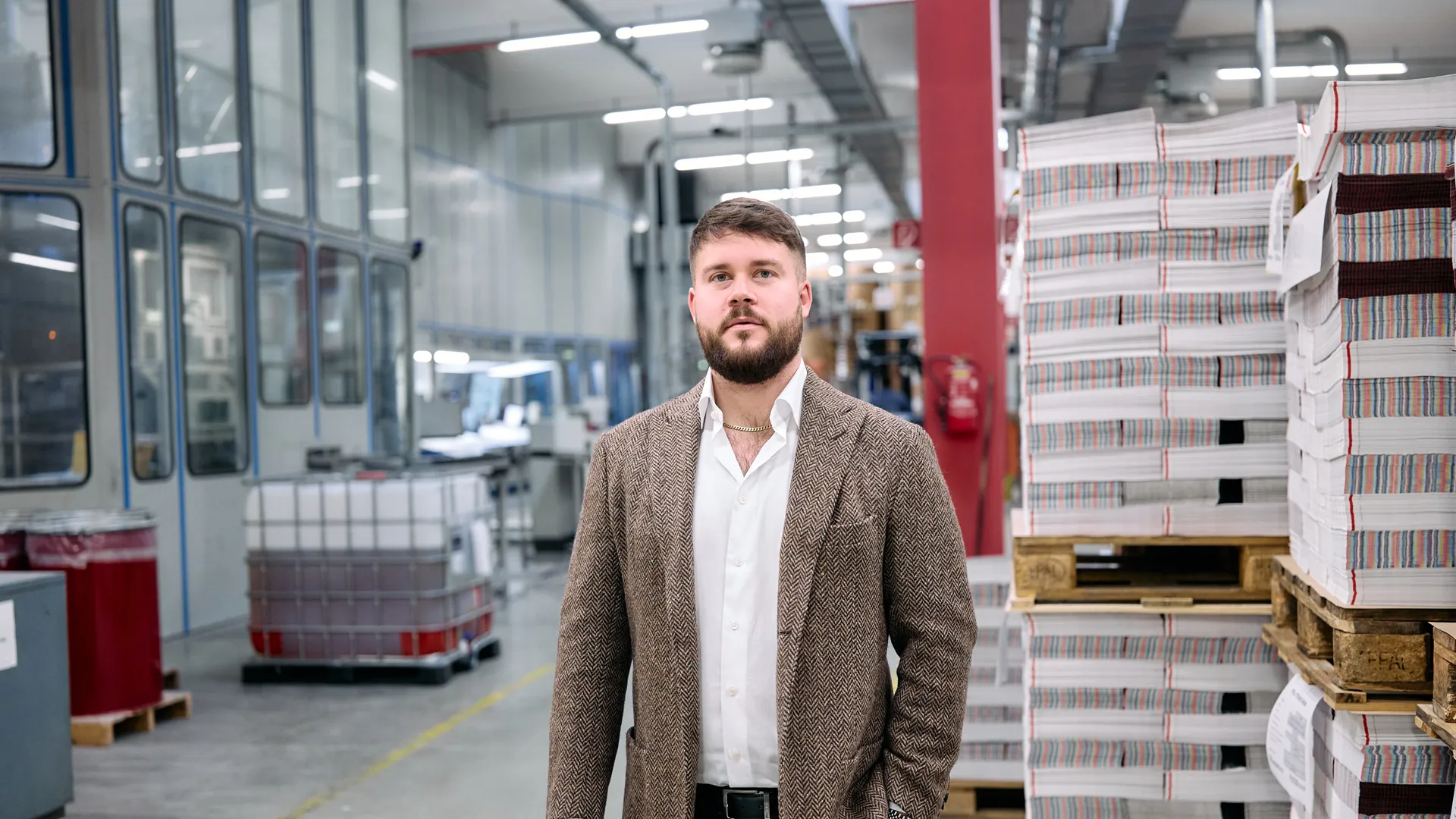
Christoph Herzog, CEO Mayr Miesbach GmbH (Photo | Stefan Hobmaier/Fotogloria)
Old technology, high load
The fans installed at the Mayr printing plant were lightyears from being energy efficient. The huge, belt-driven fan unit, which was around 40 years old, simply guzzled power. “The ventilation system runs practically around the clock in the printing plant, around 8,700 hours a year, with only 30 to 40 percent efficiency and no way to regulate it according to demand,” reports Hildebrandt. “Something had to be done urgently.”
Peter Berberski was able to convince the managing directors of the printing plant, Christoph and Ulrich Herzog, that rapid action was needed. “As a family business with regional roots, we place a high value on sustainable working practices. A retrofit that significantly reduces energy consumption and CO₂ emissions fits in perfectly with our corporate philosophy. And if it also has a positive financial impact, so much the better,” explains Christoph Herzog with a smile.
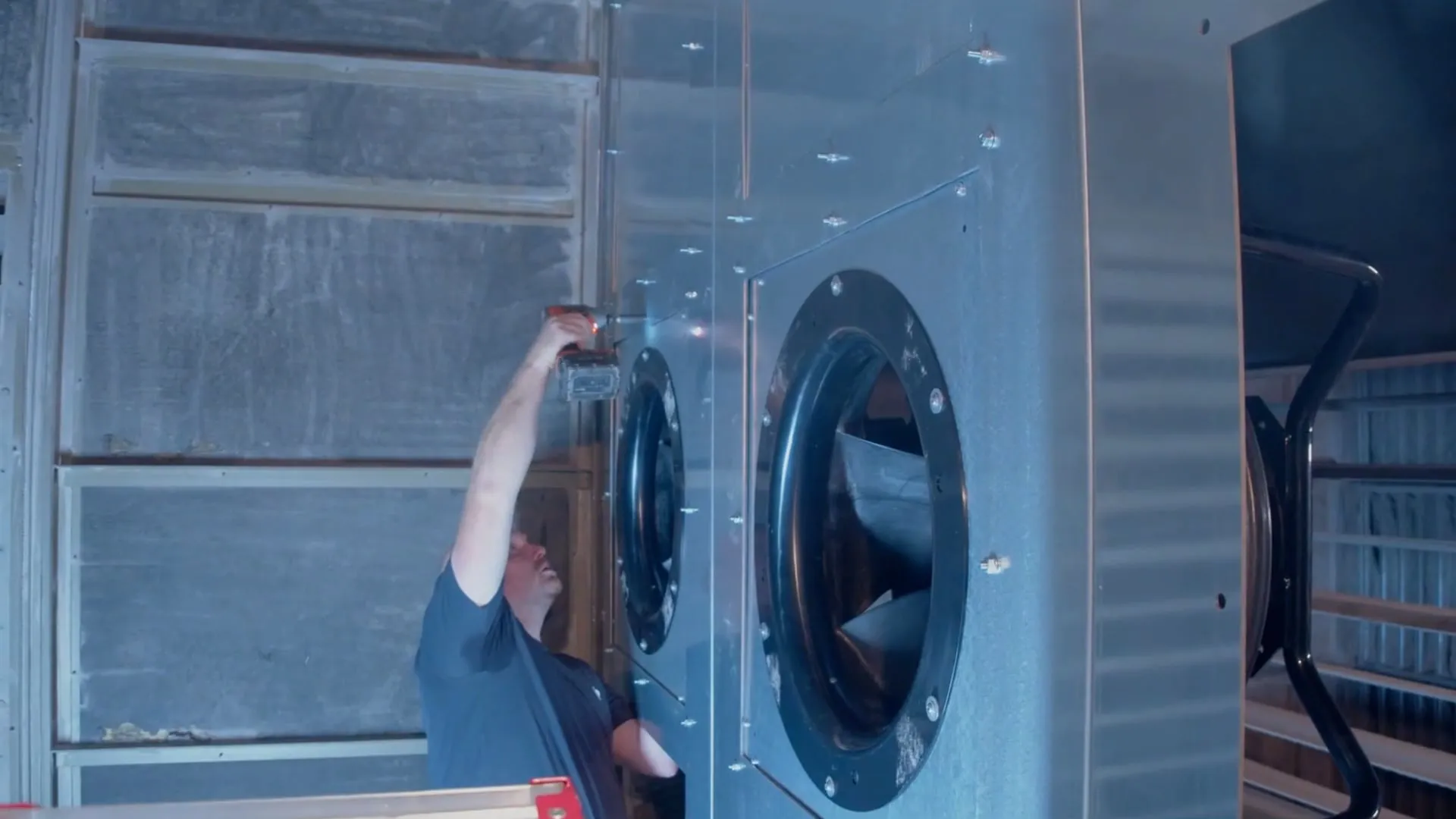
Berberski and Hildebrandt’s concept included replacing the defective control cabinet, renewing the control system and optimizing the ventilation. The installation of two FanGrids, each with six RadiPac 3 radial fans, provided a breath of fresh air. The RadiPac units, which are connected in parallel, not only increase efficiency but also operational reliability: If one fan fails, the others automatically compensate for the loss of power.
Quite heavy
Removing the old system was hard work. “The old fan unit weighed almost a ton,” says Stephan Jendrallek from Stephan Jendrallek Lüftungsmontagen GmbH, the company responsible for the installation.
Don’t forget the crane
The unit at Mayr was the biggest challenge Jendralleks team had ever faced. “We first had to completely dismantle the fan unit in a very confined space and then lift it out with a crane.”
Plug-and-Play makes it easy
As difficult as it was to remove the old system, installing the new one was a breeze. The FanGrid units are completely pre-assembled. “This allows for installation which is practically plug-and-play,” says Jendrallek.
Quickly completed
Thanks to good timing, the ventilation system was only out of operation for a short while: “October is ideal—neither too hot nor too cold,” says Jendrallek. “After three days, the system was up and running again.”
Perfect climate, lower costs
The new RadiPac fans operate quietly, hygienically and—thanks to the absence of V-belts—require little maintenance. Their higher efficiency cuts the electrical power consumption in half, reducing energy consumption by around 50 percent. “Many of our customers are unaware of how much they can save by upgrading their ventilation system,” explains Berberski, and Hildebrandt agrees: “Hardly any operators know how much energy their old ventilation systems consume. Those who modernize save money immediately—and over the long run.”

The retrofit has paid off for us. It is the best proof that sustainability and economic efficiency can go hand in hand.
Christoph Herzog, CEO Mayr Miesbach GmbH
Today, Christoph and Ulrich Herzog have no regrets about their investment: “The retrofit has paid off for us. Not only are we saving energy, but we have also optimized our production conditions. For us, this is the best proof that sustainability and economic efficiency can go hand in hand.”
Leave a comment