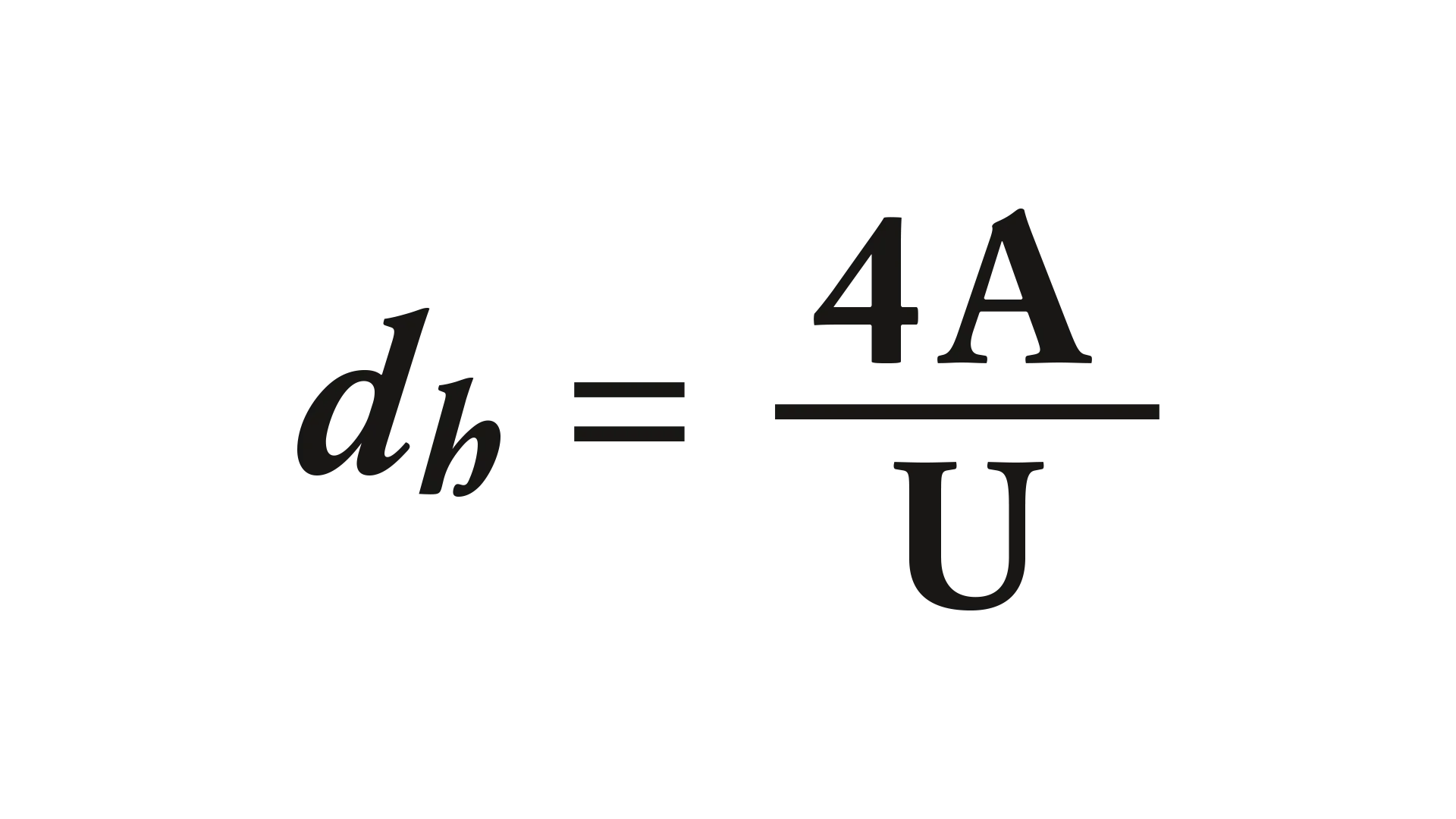

The hydraulic diameter (dh) is a calculated parameter. It allows non-circular flow cross-sections – such as rectangular or square channels – to be compared to an ideally circular pipe. The formula is surprisingly simple: It relates the cross-sectional area A through which the air flows as a ratio of the wetted perimeter U – that is, the perimeter of the duct in contact with the air. This is based on a fundamental principle of physics: The larger the flow area relative to the wall area, the more easily air can flow. This is because as soon as air flows through a duct, friction occurs at the wall surfaces – resulting in pressure losses and, consequently, energy losses. The geometry thus determines the efficiency or loss of the entire system
A large hydraulic diameter means favorable flow conditions: The air encounters little resistance, and little energy is required to achieve the desired effect. A small hydraulic diameter means more contact with the walls, greater friction, deflection, and loss. A simple illustration makes this clear: In a wide, even stream, water flows calmly and efficiently. In a shallow, winding stream, on the other hand, the water is slowed down, swirls, and loses energy. The same is true for airflows. Why is this important for centrifugal fans like the RadiPac 3?
These fans are designed to accelerate air evenly and very efficiently. However, in practice, when the air exits the fan, it often encounters rectangular housings, tight installation spaces, or otherwise unfavorable duct configurations. We’ve addressed this by significantly reducing the friction losses of air flowing from the centrifugal to the axial direction in the new RadiFlow impeller. The result: The efficiency of the entire system remains optimal for a very long time, even with a small hydraulic diameter – that is, with unfavorable duct shapes (see diagram). As a general rule, it is always worthwhile to ensure flow-friendly geometries, smooth transitions, and balanced cross-sections in the airflow path to fully exploit the performance capabilities of modern fans. The hydraulic diameter makes these relationships visible and calculable.

Leave a comment